
SUNY Potsdam Professor of English Dr. Sharmain van Blommestein Accepted to Rare Book School Course
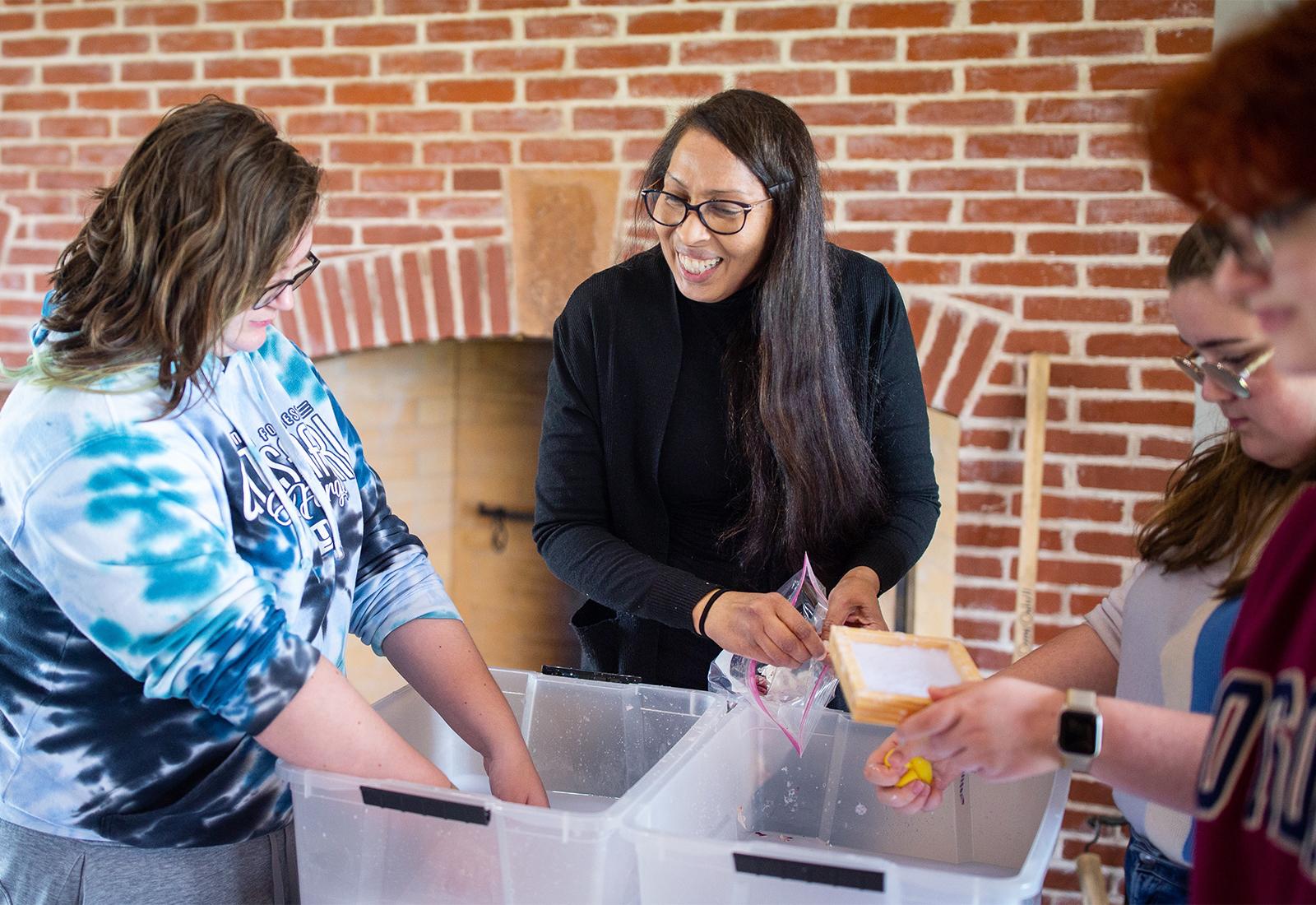
SUNY Potsdam Professor of English Dr. Sharmain van Blommestein has been selected to complete an upcoming Rare Book School course focused on the material foundations of map history.
SUNY Potsdam Professor of English, Dr. Sharmain van Blommestein, has been accepted to attend an upcoming session, “Material Foundations of Map History, 1450–1900,” at the Rare Book School, an internationally recognized program based at the University of Virginia in Charlottesville.
The course focuses on the cultural history and materiality of maps from 1450 to 1900, examining maps as historical artifacts rather than as products of mapmaking, and will support van Blommestein’s commitment to applied, hands‑on humanities teaching.
Rare Book School courses are highly competitive and typically limited to 12 participants. Dr. van Blommestein will take part in the course “Material Foundations of Map History, 1450-1900,” being held in June.
“This Rare Book School course directly strengthens my teaching in a new course I designed for the Potsdam Humanities Institute, HUMN 302: Monsters on the Edge, which I will teach in Fall 2026,” Dr. van Blommestein said. “Students work with medieval/early modern and Enlightenment‑era maps as part of our study of worldmaking, representation, and the cultural history of monstrous, engaging these materials through close, applied analysis in digital environments. While my current preparation is sufficient to teach the material, this training will deepen my expertise and expand the range of primary sources and interpretive frameworks I can bring into the classroom.”
The new HUMN 302 course is developed as part of the Potsdam Humanities Institute’s microcredential program, Humanities for Thoughtful Leadership. It also aligns with SUNY’s High-Impact Practice initiative, particularly material culture analysis, archival literacy and applied learning. The course will allow van Blommestein to broaden the experiential components available to students, and enhance the Potsdam Humanities Institute’s commitment to interdisciplinary, hands-on humanities work.
As Dr. van Blommestein mentioned, participation in the Rare Book School course will enhance her already well‑established practice of incorporating applied learning into humanities instruction. She has previously led hands‑on workshops on papermaking, writing with quills and fountain pens, letterlocking, and applying wax seals as part of the College’s LoKo Arts Festival; with local high school students through the history department’s social studies field‑trip programs; and, most importantly, through the applied‑learning component of her Linguistics, LNGS 309 course, Cultural History of English: Writing Technologies, which culminates in a display of student work at the Crumb Library.
Dr. van Blommestein earned her Ph.D. from the University of Florida and is a professor of English at SUNY Potsdam, where she also serves as associate chair of the Arts and Humanities Division (Art, English, History) and as the campus Collaborative Online International Learning (COIL) Coordinator. Her teaching and scholarship span medieval and early modern studies, women’s and gender studies, and literary theory, and she regularly teaches British and American literature through interdisciplinary, theory‑driven courses.
Dr. van Blommestein is actively engaged in COIL partnerships with institutions in Montenegro, Spain, Türkiye and Romania, designing intercultural learning activities that invite students to examine individual and collective identities across global contexts. Her research examines the cultural and political dimensions of semiotic bodies, memory, and markings, bridging medieval/early modern and contemporary frameworks to explore ideologies of the gendered body and the concept of the reading the body. In addition to her disciplinary teaching, she teaches courses grounded in Instructional and Universal Design and has held several leadership roles at SUNY Potsdam, including as director of women’s and gender studies, director of the Office of Student Research, and chair of the Department of English.
Rare Book School provides innovative and outstanding educational opportunities to study the history, care, and use of written, printed, and digital materials. Through the hands-on, intensive examination and analysis of textual artifacts in seminar-style classes taught by an international faculty of distinguished scholars and professionals, Rare Book School fosters the knowledge and expertise essential to the responsible stewardship of the historical archive in all its richness and pluriformity. Promoting a spirit of learning and intellectual generosity, Rare Book School builds and enriches relationships among booksellers, collectors, conservators, educators, librarians, and other individuals from around the globe to create a community equipped to advance historically informed understandings of our cultural heritage.
SUNY Potsdam’s Department of English challenges its students with courses that develop their abilities to interpret a variety of written, oral, and multimedia forms in which humans communicate with one another, as well as to express themselves effectively in those forms. For more information, visit www.potsdam.edu/academics/AAS/Engl.
About SUNY Potsdam:
Founded in 1816, The State University of New York at Potsdam is one of America’s first 50 colleges—and the oldest institution within SUNY. Now in its third century, SUNY Potsdam is distinguished by a legacy of pioneering programs and educational excellence. The College currently enrolls approximately 2,500 undergraduate and graduate students. Home to the world-renowned Crane School of Music, SUNY Potsdam is known for its challenging liberal arts and sciences core, distinction in teacher training and culture of creativity. To learn more, visit www.potsdam.edu.
Arts & Culture General News