
Lying flat on the ground, arms extended into an excavation unit, Ryan Duryea ’28 and Natalie Deso ’28 use trowels to remove soil from their research site. Carefully scraping away one layer of dirt after another, they’re searching for artifacts from another time—an age of wilderness tourism dating back to the late 1880s.
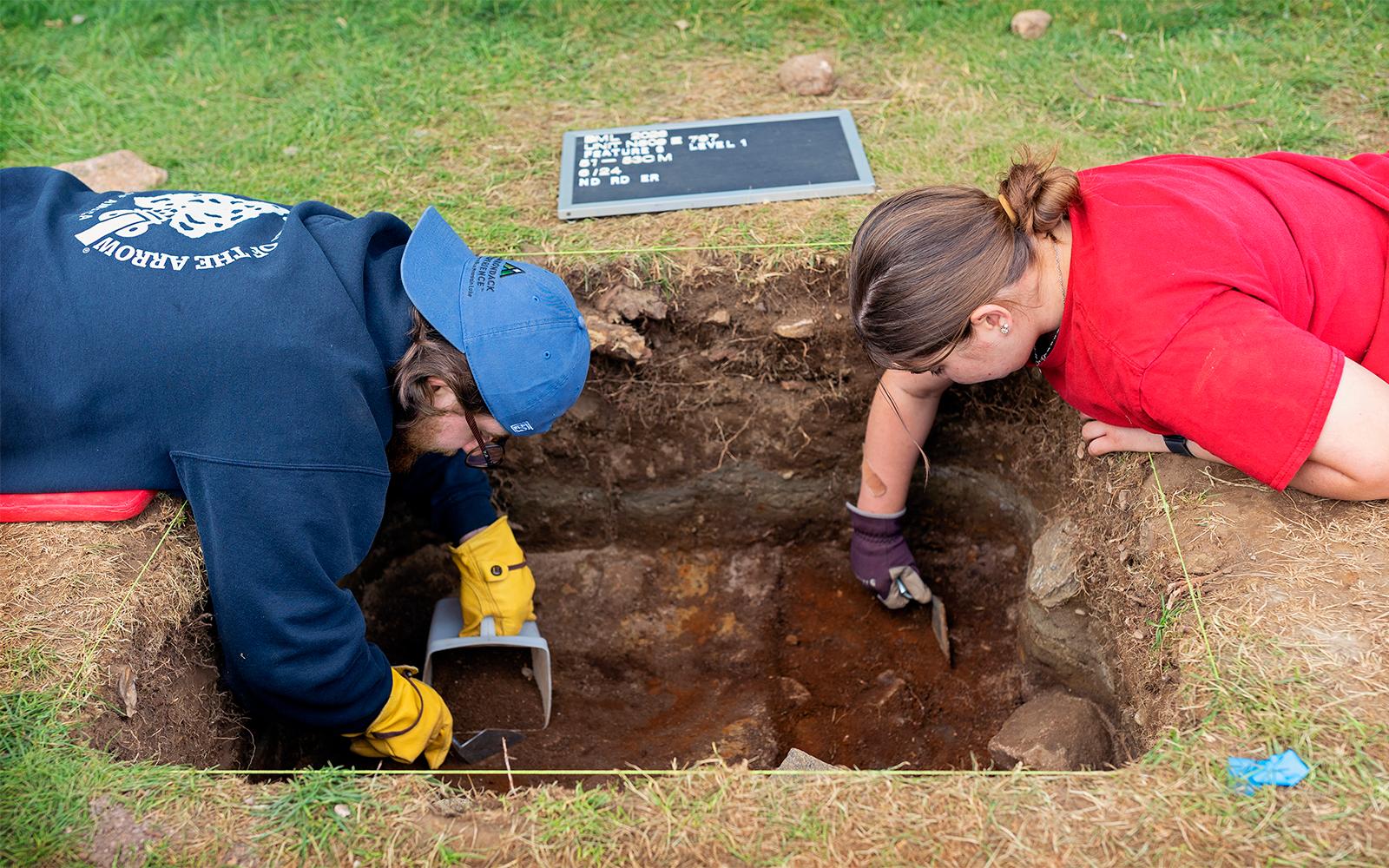
Ryan Duryea ’28, left, and Natalie Deso ’28 work on their excavation unit.
Part of SUNY Potsdam’s Archaeology Field School, 12 students completed an immersive, month-long dig this summer in the heart of the Adirondacks. Led by Dr. Hadley Kruczek-Aaron, a professor in the Department of Anthropology, the Field School epitomizes the College’s emphasis on experiential learning—hands-on opportunities she has created for her students over the past two decades.
“I really enjoy teaching Field School because I get to see the students challenged in so many different ways. They’re finally getting a chance to take the knowledge that has only been presented to them in textbooks and on screen, and then I get to really see them respond to that challenge.”
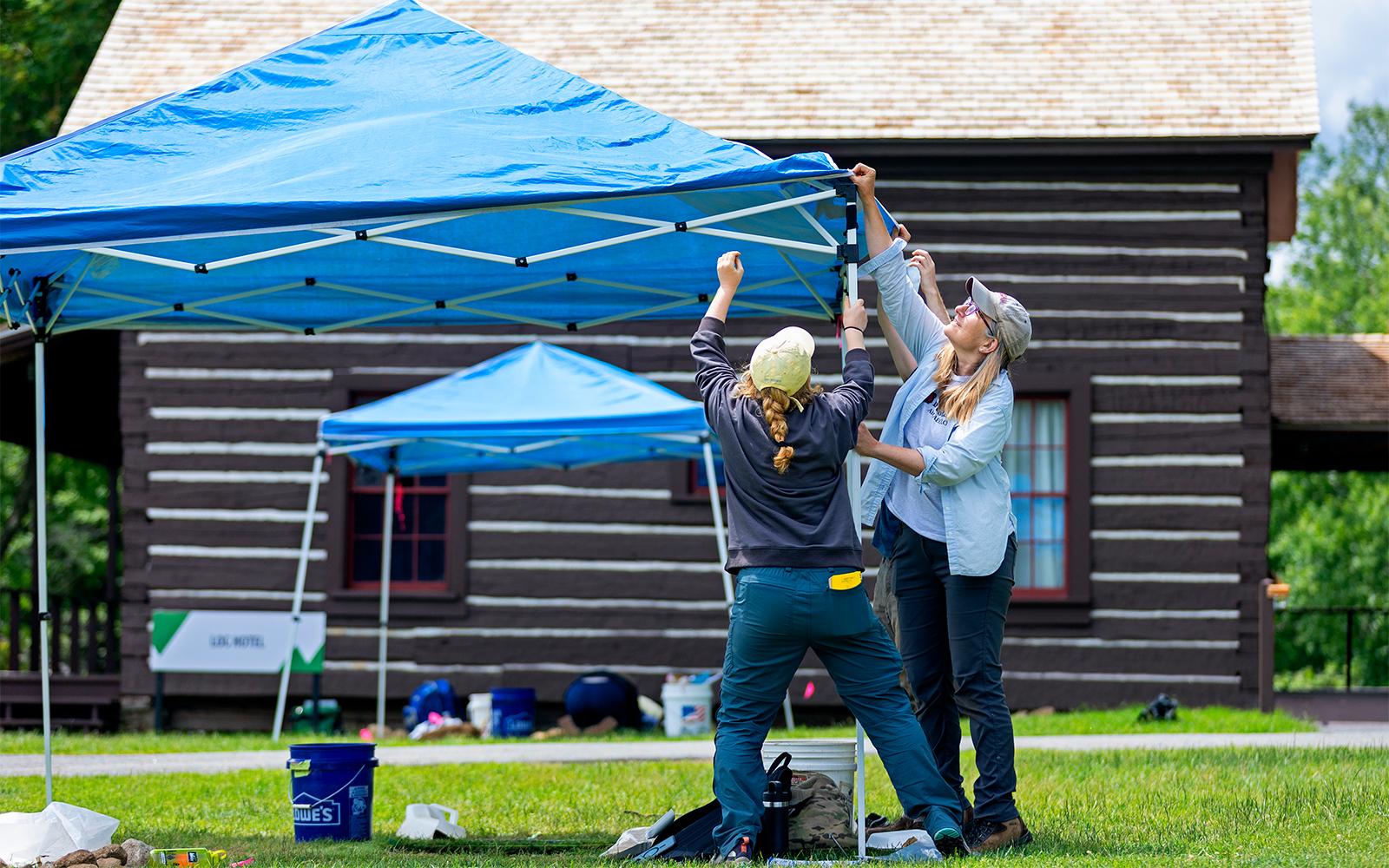
Kruczek-Aaron, right, helps a student secure a blue tent over an excavation unit, used to protect artifacts from sun, wind, and rain and to prevent the soil from drying out. In the background is the Log Hotel, still standing in the same spot it was built in 1876.
Secrets in the Soil
With a continued focus on the rich history of the Adirondacks, this year marks the ninth Field School that Kruczek-Aaron has led. This summer, her students explored the land around the former Blue Mountain House (built in 1880, demolished in the 1950s) and the Log Hotel, still standing on the same spot where it was erected in 1876.
“The Adirondack Experience invited us to celebrate the 150th birthday of the Log Hotel,” Kruczek-Aaron said. “That hotel ushered in this new era of wilderness tourism in the Adirondacks, so it’s been preserved by the museum as a relic, as an artifact of that era. As part of that commemoration, we’ve been doing archaeology to be able to document life in the hotel era.”
Spread out around the grounds of the museum, students work in teams at their excavation units, eyes fixed on the soil within a gridded square, as they peel back layers of material culture to reveal stories from the past.
“We know that the family that owned the hotel, the Merwins, were religious folks who were against alcohol consumption, and so we’re seeing a lot of spring water bottles. We found a German stoneware ceramic bottle, a mineral water bottle from Hungary and a couple of bottles from Saratoga—a fascinating snapshot of how big the reach of the market was,” Kruczek-Aaron said.
A midden, or ancient heap of refuse, yields some of the most interesting results for the young archaeologists. Layers upon layers of artifacts, tossed off a hillside near the Log Hotel, reveal signs of life from the late 19th century, when visitors made the long trek to this remote region of the Adirondacks.
“The goal of this field school is to investigate the lives of the people who built, lived in and visited the Log Hotel and Blue Mountain House on this property,” said SUNY Potsdam alumna Amber Rounds ’19. “Most of the artifacts that we’re finding, especially on the midden, are all dating to the 1880s and 1890s, which is great, because that’s the period that we’re interested in—that was when this hotel was at its peak. In one five-meter by five-meter square, we had over 2,400 artifacts come out of just that one small space.”
Passing Down the Trowel
Rounds attended the Field School at John Brown’s Farm in 2017 as an undergraduate pursuing her degree in Archaeological Studies and Anthropology. Since then, she has built an impressive career as an archaeologist, including her current position as Archaeological Technician III for Gray & Pape, Inc.
“Amber is an alum from 2019. She was my T.A. for my last Field School in 2024. She’s excellent and has been out in the workplace," Kruczek-Aaron said. "I always like to have one T.A. who is out in the real world, so that students can get insight into that world.”
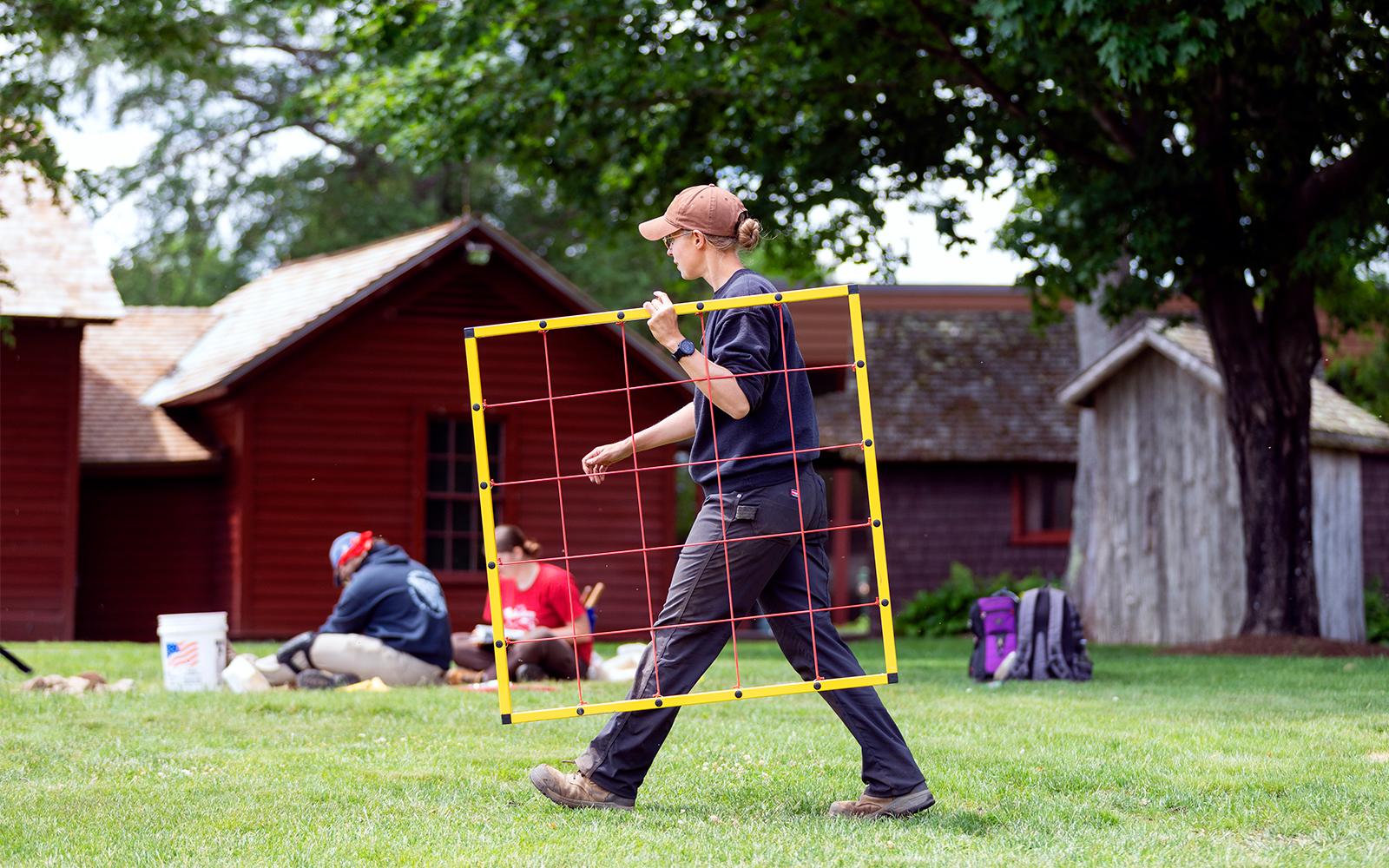
Amber Rounds '19 carries a one-meter collapsible archaeological mapping frame to one of the excavation units.
A second teaching assistant, Euan Reynolds ’26, who just graduated with a degree in archaeological studies, was also hired to help lead the dig, with a focus on interacting with inquisitive visitors to the museum grounds.
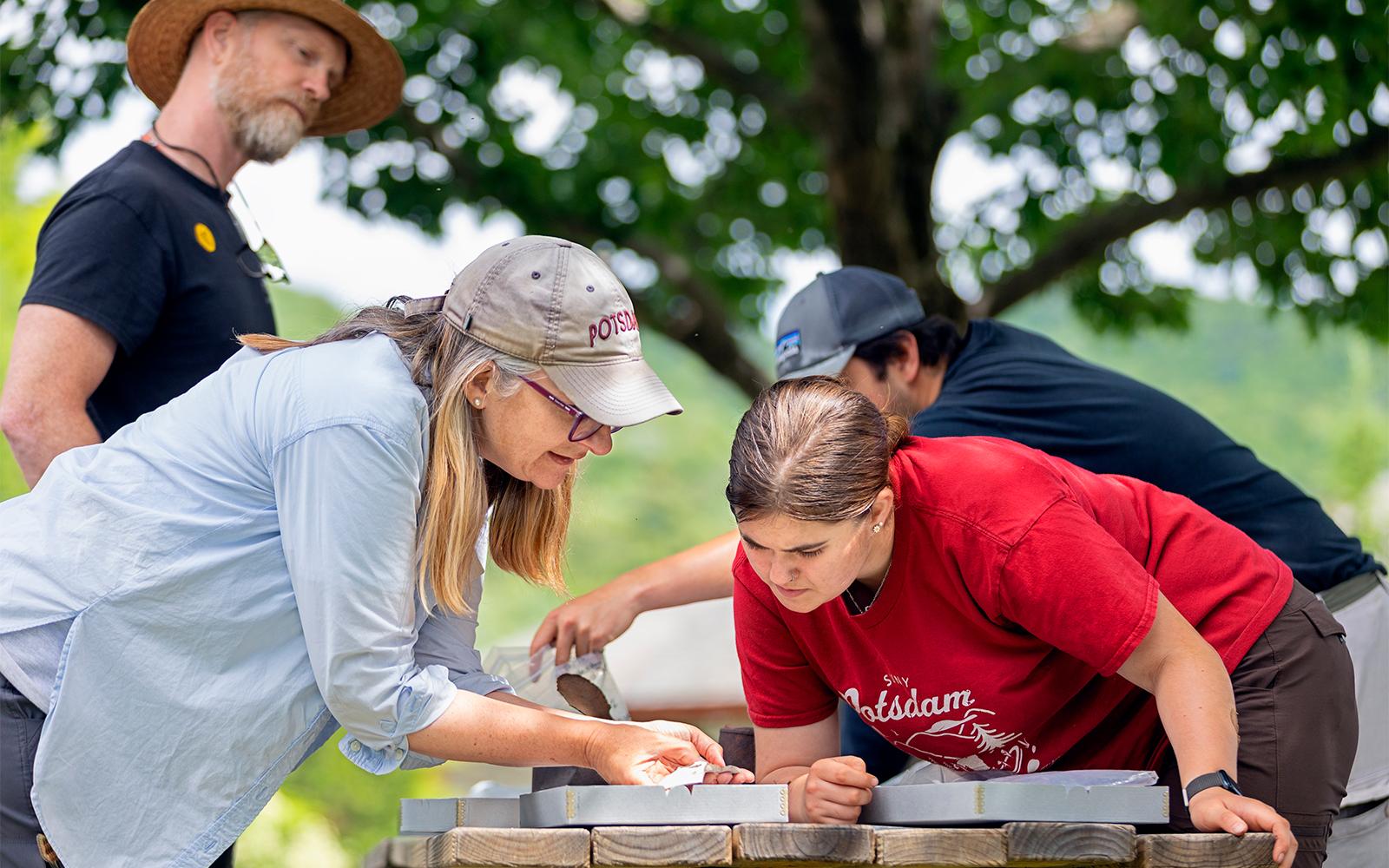
“There’s a big public outreach component to our Field School this year because we’re in a museum in a public setting, where there are a lot of people asking questions and interaction happening. Every day at 1 p.m., we have outreach under the pavilion, so people can come and see some of the artifacts that we’ve found. Euan and at least one other student from the field school are there to help answer questions,” Kruczek-Aaron said.
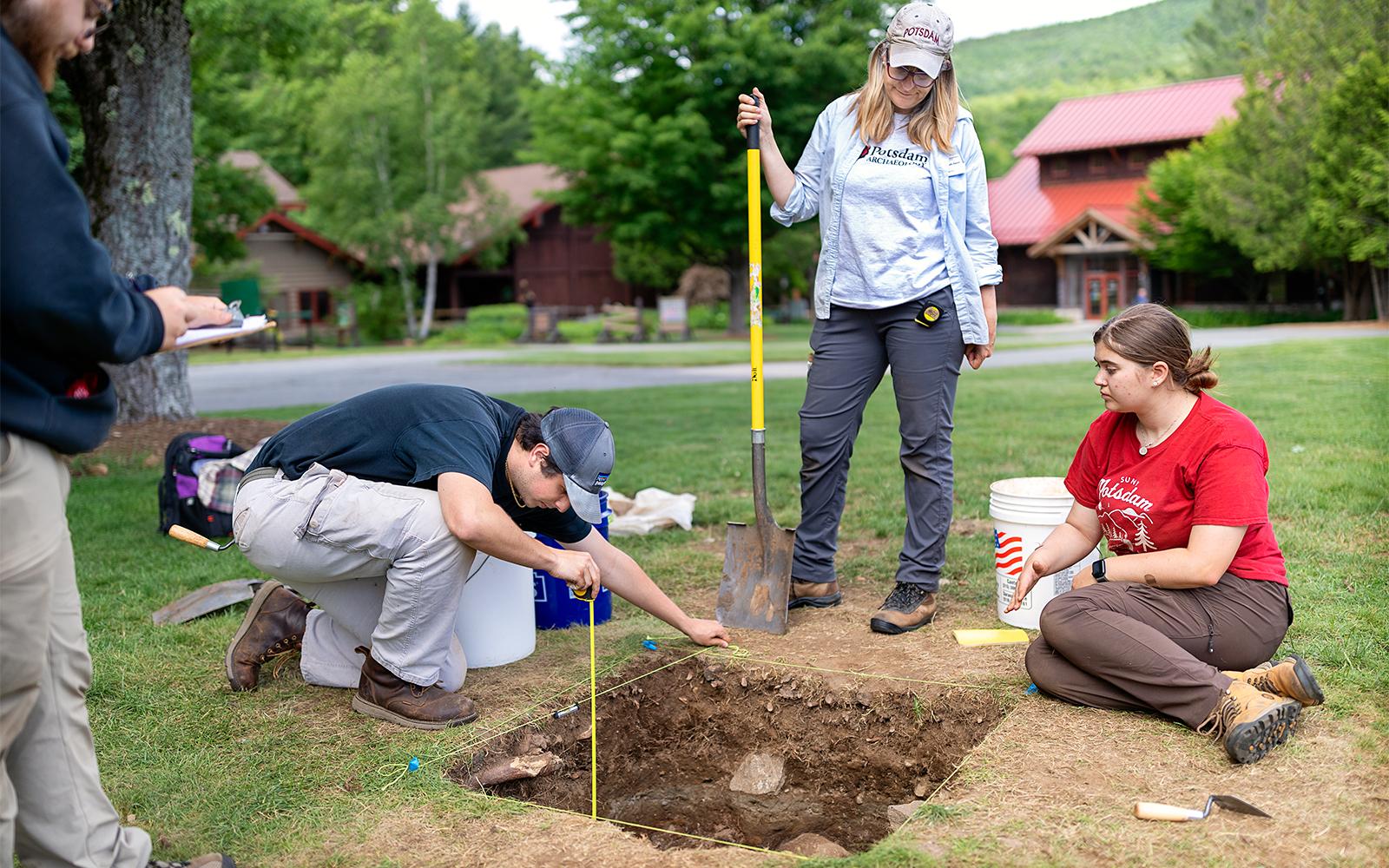
From left, Euan Reynolds ’26 measures an excavation unit while working with Dr. Kruczek-Aaron and Natalie Deso '28.
As families walk around the dig, students explain the process and talk through the artifacts they’ve unearthed. Children crane their necks to peer into the excavation units, then head home with “junior archaeologist” stickers collected from the crew.
“We’re in a very visible and accessible place here on the museum grounds, so we’ve been fortunate to have this opportunity to talk to people—that’s another facet of the experience. Students are really honing their communication skills, learning not to use jargon, and talking to people in a way that gets their attention and helps them understand what archaeology is,” Kruczek-Aaron said.
Textbook to Trench
Employing techniques honed through the Archaeological Studies program—skills developed on SUNY Potsdam’s campus in the labs and a mock excavation site—most students arrive already comfortable identifying soil changes, recognizing artifacts, using a screen and completing the paperwork needed to track their work.
“Usually, students have taken an Introduction to Archaeology class, and most of them have taken one of our upper-division classes like Archaeological Procedures, which gets them into archaeological methods with more advanced content and conversation. So, they’re usually more than ready to get out here, and you see that,” she said.
Despite the preparation, the demands of the Field School can only be appreciated once the students arrive in person. The challenges come in many forms: the physical requirements of seeing through a stratigraphic excavation, the environmental strains like bugs, heat and rain, and the social test of living and working alongside the same cohort for an entire month.
"Probably the most challenging aspect of Field School can be the social dimension," Kruczek-Aaron said. "You have students who are working and living with their peers; that's a lot to navigate in four weeks. How they respond to that, how well they work with people, and what kind of problem-solving skills they have—that's often the really challenging piece. I always say a field experience is so telling about how students are going to handle the challenges of a job."
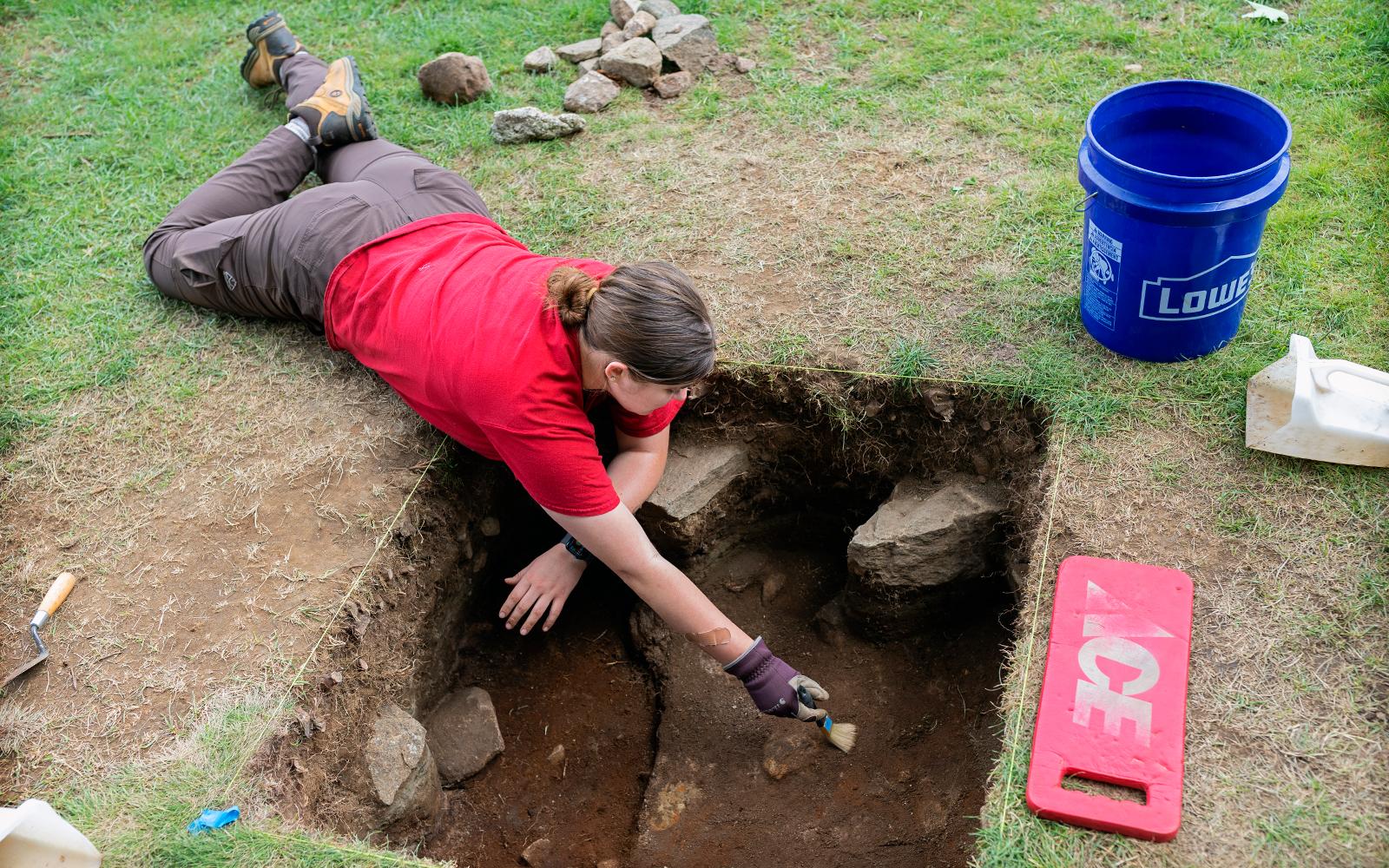
Natalie Deso '28 uses a brush to carefully remove sediment from her excavation unit.
After building interpersonal skills, developing a tolerance for the elements and gaining hands-on experience conducting an archaeological dig, students will return to campus this fall better prepared than ever. With hundreds of artifacts in tow, they’ll be examining their findings in Kruczek-Aaron’s Archaeological Lab Techniques class, cleaning, cataloging and reconstructing 19th-century vessels from their summer finds.
“I’m hoping that the objects that we’re finding will become an exhibit that the museum will put together in the future on the archaeology of the Log Hotel, so the fruits of our labors will continue,” Kruczek-Aaron said. “The story that these objects are telling is going to keep having an audience—the labor of all the students here will really pay off and give the museum something, and help be a teaching tool in the future.”
Article and photos by Jason Hunter