
Creating art has always been a cathartic experience for MJ Rowe ’26.
A paintbrush and a camera lens became her earliest tools for expression—helping her navigate mental health challenges throughout her youth. Now, as she completes her degree in studio art, Rowe is looking ahead to graduate school in art therapy, with the goal of helping others discover the same healing power she found through creativity.
“Art has always been therapy for me. I found so much joy in helping my peers in high school in the art room,” she said. “I wanted to find a way to continue my art throughout adulthood by providing one-on-one sessions and creating a therapy that works, giving people an outlet to express emotions they have a hard time verbalizing.”
When Rowe first arrived at SUNY Potsdam, she enrolled in the art education program before realizing that a degree in studio art, with a mix of psychology classes, would more closely align with her career aspirations to be an art therapist.
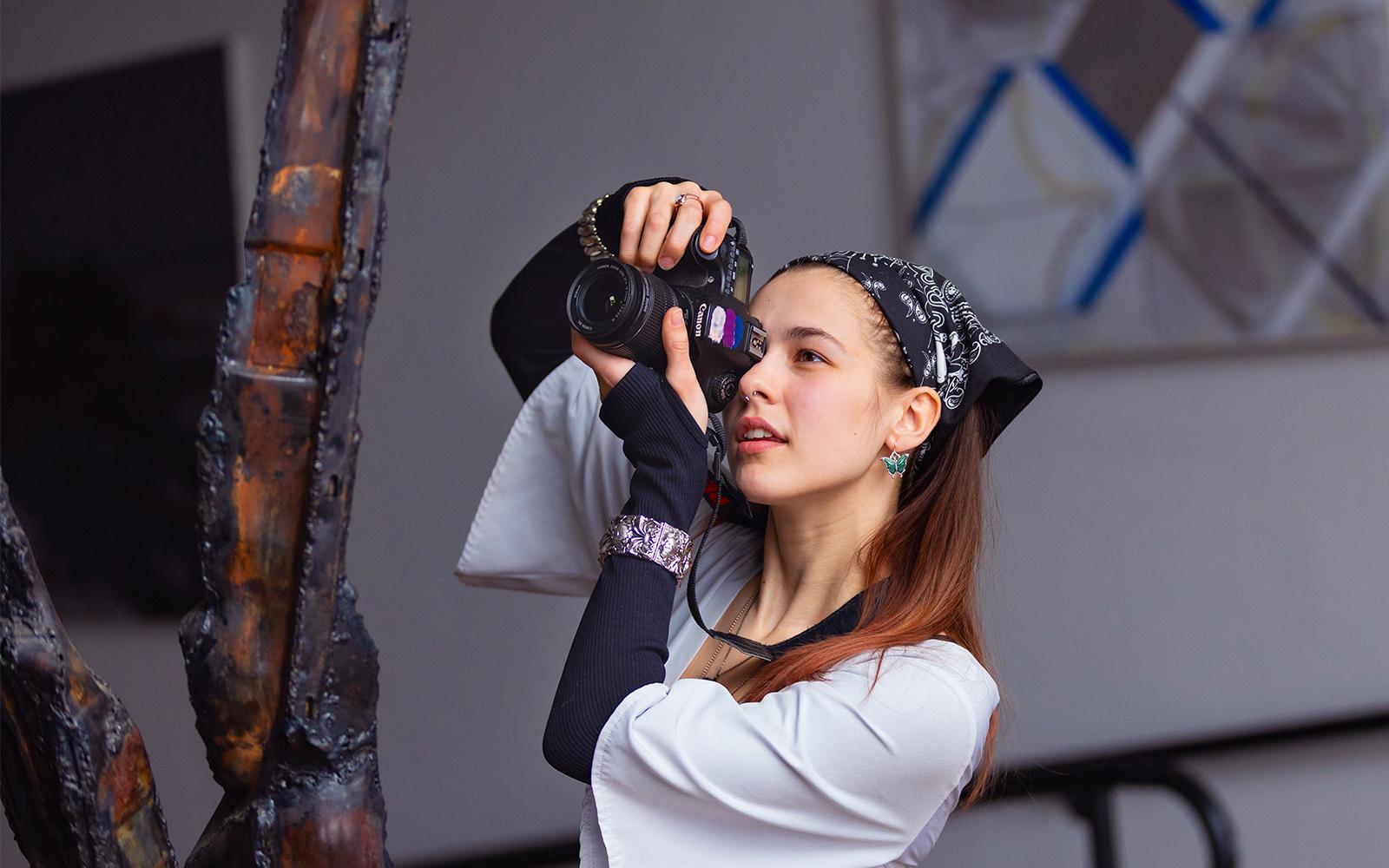
Her path is deeply personal. Drawn to music and the arts from an early age, Rowe turned more intentionally to the visual arts in middle and high school, using painting and photography to process stress and express complex emotions.
“I was always a little more neurodivergent as a kid and didn’t necessarily get the therapy that I needed, so the art room was therapy for me. It was the place where I learned how to communicate these emotions,” she said.
The daughter of a Methodist minister, Rowe grew up in a loving household, though one shaped by a strong religious framework. As a child, grappling with ideas of morality, damnation, her sexuality, and her mental health created a sense of fear and internal conflict.
“Growing up religious, I had a very hard time with my morality. As someone who is bipolar, I hyper-fixated on such a heavy, nuanced existential question—it didn’t feel like anything that I could do would free me from the sin that I was entrenched in,” she said. “So, art became a place to express those weird things—the eating disorder that I experienced in high school, the emotions, the rage, all that stuff. Art was a place that felt a little separated from me. If it was on the page, it wasn’t in me—it was out, and I didn’t have to deal with it anymore.”
That connection between art and healing has continued to shape her work at SUNY Potsdam. Rowe is currently completing a self-portrait series for an upper-division photography course, exploring her experience with bipolar disorder. The nontraditional close-up portraits range from stark black-and-white images to vivid color, visually representing the emotional spectrum she navigates.
“Something I talk about in the paper I’m currently writing is that the instability of bipolar disorder is so chaotic. The black-and-white photos resemble the flatness experienced in depressive episodes—the numbness represented through a desaturated palette—while manic episodes are very brightly colored, very intense and a little unsettling,” she said.
Her interdisciplinary studies bring her from the photography studio to the psychology classroom. This semester, she is taking Theories of Personality with Dr. Jim Fryer, a course that has deepened her understanding of human behavior.
“I’ve taken a couple classes with Dr. Fryer. I love that guy so much. He takes a lecture hall, which I have a hard time with, and makes it so fun. You can tell he was in theater in high school. He’s very engaging—having a lecture that’s a little more of a discussion. I really like that,” she said.
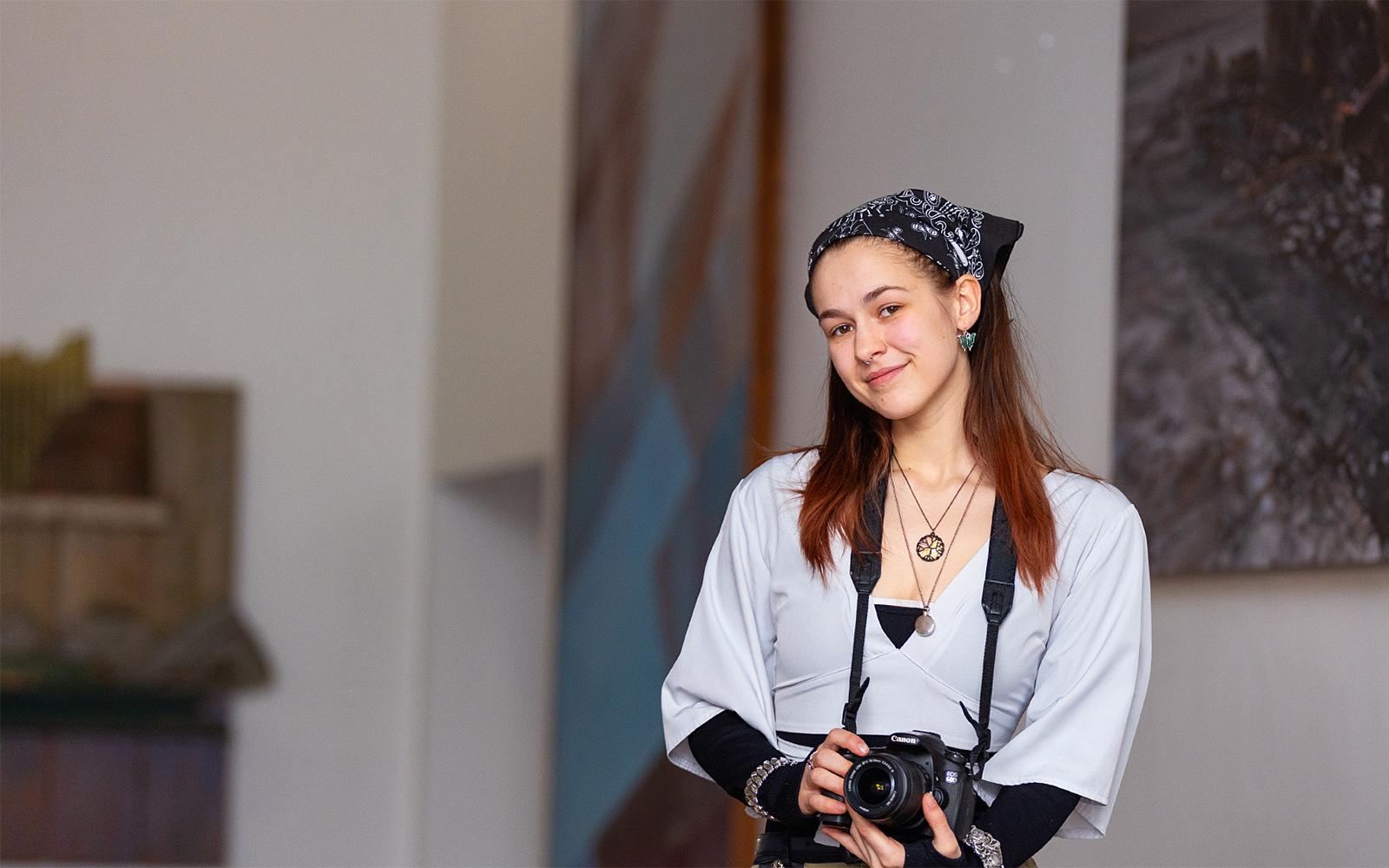
Outside the classroom, Rowe was a member of A Sharp Arrangement, one of the college’s outstanding a cappella groups. She also recently photographed her first wedding, capturing striking portraits of a couple in the snow. Looking back, Rowe says the relationships she’s built at SUNY Potsdam stand out most. From the very beginning, she discovered a strong sense of belonging.
“I found the people that I’m currently friends with on the second day of college. I don’t think most people find their group that quickly,” she said. “It’s astounding to me how ostracized I felt in high school, but the friends I’ve met here are some of the most understanding, communicative, loving, like-minded people.”
Rowe has excelled academically as well, earning a place on the President’s List for the Fall 2025 semester. As she prepares to graduate, she is focused on building a future where she can combine art and psychology to support others navigating mental health challenges.
“I’ve always found the most fulfillment in life by helping those around me," Rowe said. "Potsdam cultivated that aspect of myself and taught me how apply it: by pursuing a career in art therapy.”
Article by Jason Hunter