
Bradley Cech’s long “Yes” to chemistry
Eleven and a half years into his study, Dr. Bradley Cech ’18 is still discovering new things on the amorphous frontiers of chemistry. The Plattsburgh native leveraged his dual bachelor’s degrees in chemistry and math from SUNY Potsdam to complete a doctorate at the University of Vermont before continuing east to Bates College, where he began a new role this semester as a visiting assistant professor of chemistry and biochemistry, sharing his passion for discovery with students.
“Chemistry is rigorous, and I think students deserve to hear that honestly,” Cech said just a couple of weeks into the start of classes. “At the same time, that difficulty is part of what makes it rewarding. Over time, you become better at taking a complicated problem apart and figuring out what information actually matters. That way of thinking ends up being useful far beyond chemistry.”
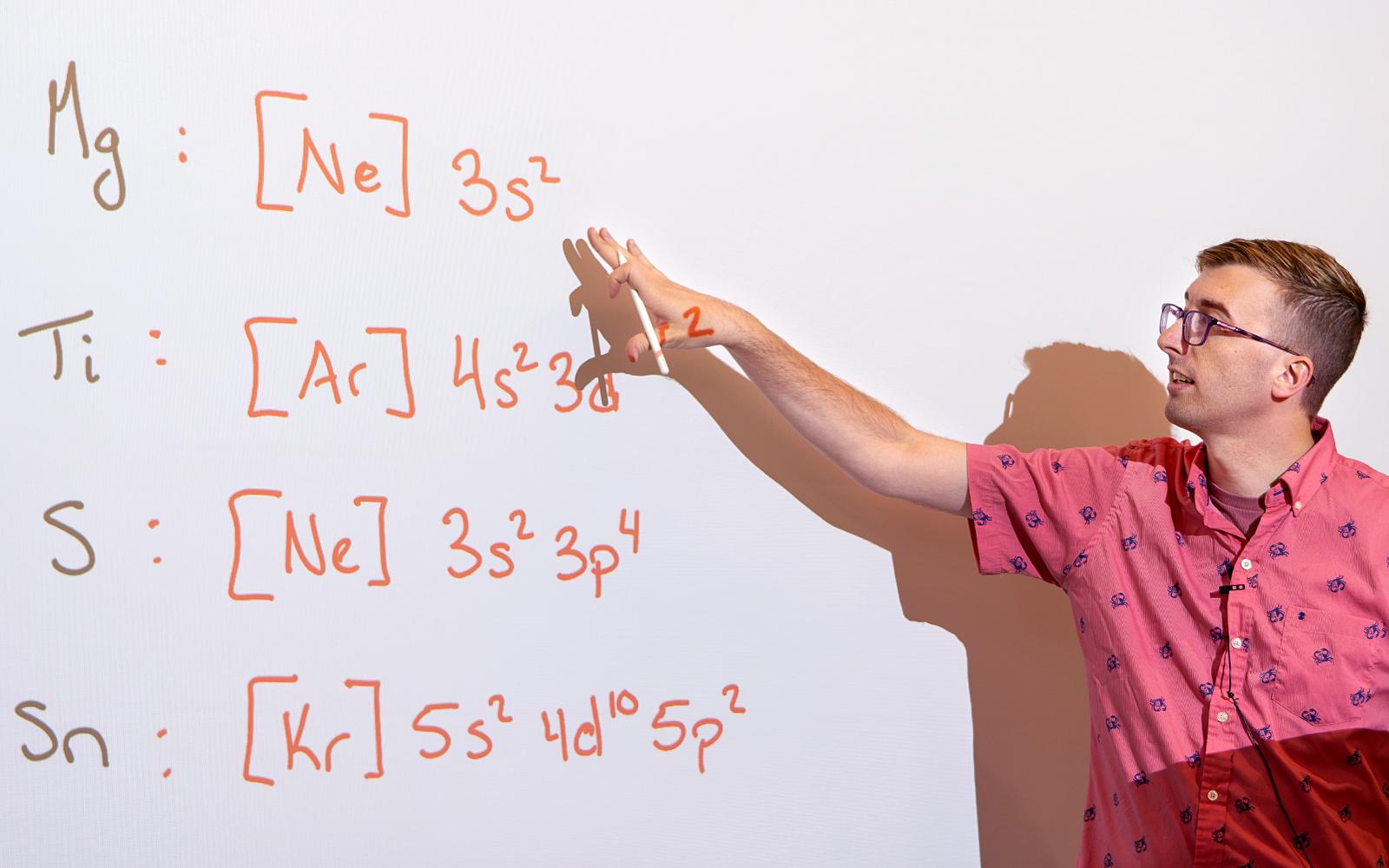
Cech loves puzzles. The intellectual challenge of chemistry and math drew him into the fields, with the call going as far back as Beekmantown High School. Each discipline offers something deeply satisfying—math’s structured problem solving is flavored with the mysteries of why materials behave as they do and what is going on at the molecular level.
“Sometimes chemistry is very mathematical, other times you need to visualize a structure or recognize a pattern before you can even begin solving the problem,” Cech explained. “What continues to fascinate me is that chemistry lets us understand things we cannot directly see.”
His doctorate work is a perfect example.
“I studied the layer of proteins that forms on a nanoparticle when it enters a biological environment,” Cech said. “You cannot look at a vial and see that layer forming, but with the right chemistry and microscopy, you can begin to measure it and understand how it changes over time. There is something really satisfying about taking a phenomenon that is essentially invisible and designing experiments that allow you to understand it.”
Mentoring and foundational inquiry at Potsdam
Teaching has added synergy to Cech’s chemical fascination, for now he is in a position to help students make these kinds of leaps in knowledge for themselves.
“The chemistry department at Potsdam had an enormous influence on me,” he said. “It was a place where I felt known as a student and where the faculty were genuinely invested in what I was doing.”
Cech’s academic and research advisor, Dr. Maria Hepel, helped nurture and guide Cech’s passion, introducing him to the world of nanoparticles through undergraduate research. The experience was the starting point for the scientific direction Cech would take with him to graduate school. The research centered on silica nanoparticles and the controlled release of anticancer drugs—acquainting Cech for the first time with scenarios where the answers were not already known.
“The research changed the way I thought about science and helped me become comfortable with the fact that an unexpected result is not necessarily a failed experiment,” he said.
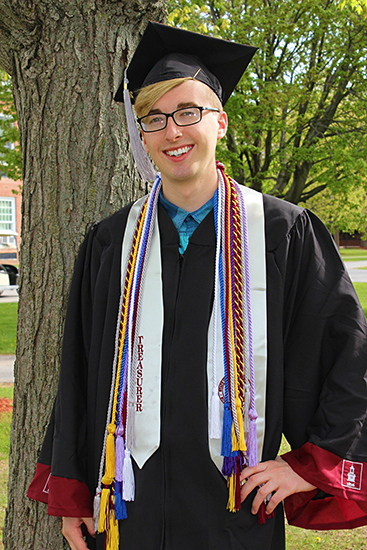
Cech’s dedication to the Potsdam experience extended beyond the academic. In student life, he stayed busy as well, serving as treasurer of the Student Government Association and helping steward a $100,000 capital projects initiative guided by student input. Discovering Potsdam at all was a sort of happy accident. In the North Country to tour other campuses, he immediately felt the vibe of SUNY Potsdam was the right fit, and receiving the prestigious Mt. Emmons Scholarship helped convince him he was making the right choice.
“What I could not fully appreciate at the time was how important the chemistry department would become to me,” he recalled. “The faculty mentorship and the chance to get involved in research ended up shaping much more than just my time at Potsdam.”
By the time Cech had concluded his education in the shadow of Adirondacks, he was certain he wanted to continue in research and knew he wanted to expand on his nanoparticle work with Dr. Hepel. Graduate school fell into place naturally.
“UVM let me stay in the nanoparticle world while moving into analytical chemistry, biological systems and microscopy,” he said.
The road to Bates
Cech’s passion fueled him through a purposeful seven and a half years of work toward his doctorate in Burlington.
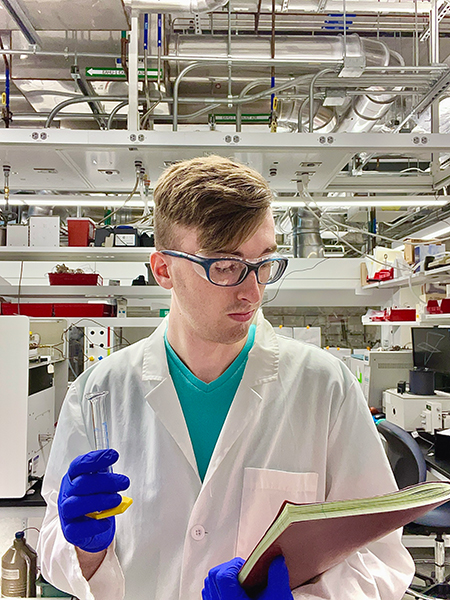
Laser-focused on understanding the protein corona that forms on nanoparticles using super-resolution fluorescence microscopy, Cech and his fellow researchers developed a way to directly visualize and quantitatively measure the protein layers. The breakthrough became not just a singular point of satisfaction for Cech but also the foundation of his dissertation. Along the way, he discovered that teaching was one of the most gratifying aspects of the work.
“I enjoy helping students move past the assumption that struggling with chemistry means they are bad at it,” he said. “Often, they simply need more time or a different way of approaching the problem.”
Looking toward his future, Cech began to search for an institution where he would be able to teach and remain engaged with science. He found a dream position at Bates, a small, prestigious private college in Lewiston, Maine, where his goal is to help students build a strong foundation and confident approach to chemistry problems. He loves that analytical chemistry allows him freedom to connect techniques to real questions.
“I am building much of the course and laboratory material myself, so I do not want students simply learning how an instrument works,” he said. “I want them thinking about why they would choose one technique over another and what the resulting data actually mean.”
Looking ahead, Cech wants to be deeply involved in an institution “where students become genuine participants in research.” He looks forward to discovering the kind of professor he wants to be and what he’ll learn about the realities of leading a classroom.
Looking back on key lessons over nearly a dozen years of the journey, Cech urged students to take advantage of what Potsdam can give.
“Get to know your professors and try research if you have the opportunity,” he said. “Some of the experiences that ended up shaping my career started because I said yes to something before I fully understood where it might lead.”
Article by Bret Yager