
At the heart of SUNY Potsdam's creative writing program is Sara Cantwell '14 & '17—a writer, editor, and educator who brings a community-focused approach to everything she does.
As coordinator for the B.A. in Creative Writing program, she emphasizes student support and peer-to-peer mentoring above all else.
“A huge part of my teaching practice is trying to develop a sense of community within my students. Yes, we’re going to meet and talk about craft and how that’s employed, but it’s also about developing that community of practice as artists.”
Cantwell teaches everything from poetry and creative writing to a capstone course for upperclassmen focused on assembling and refining a portfolio of written work.
“My goals as a professor are a little bit different than maybe previous generations of creative writing instructors. There is historically a lot of what I dub, ‘skill and drill,’ which is, especially in poetics, to learn meter,” she said. “I’m much more concerned with students finding parts of craft that resonate with them, which means I ask them to do a lot of experimentation early on.”
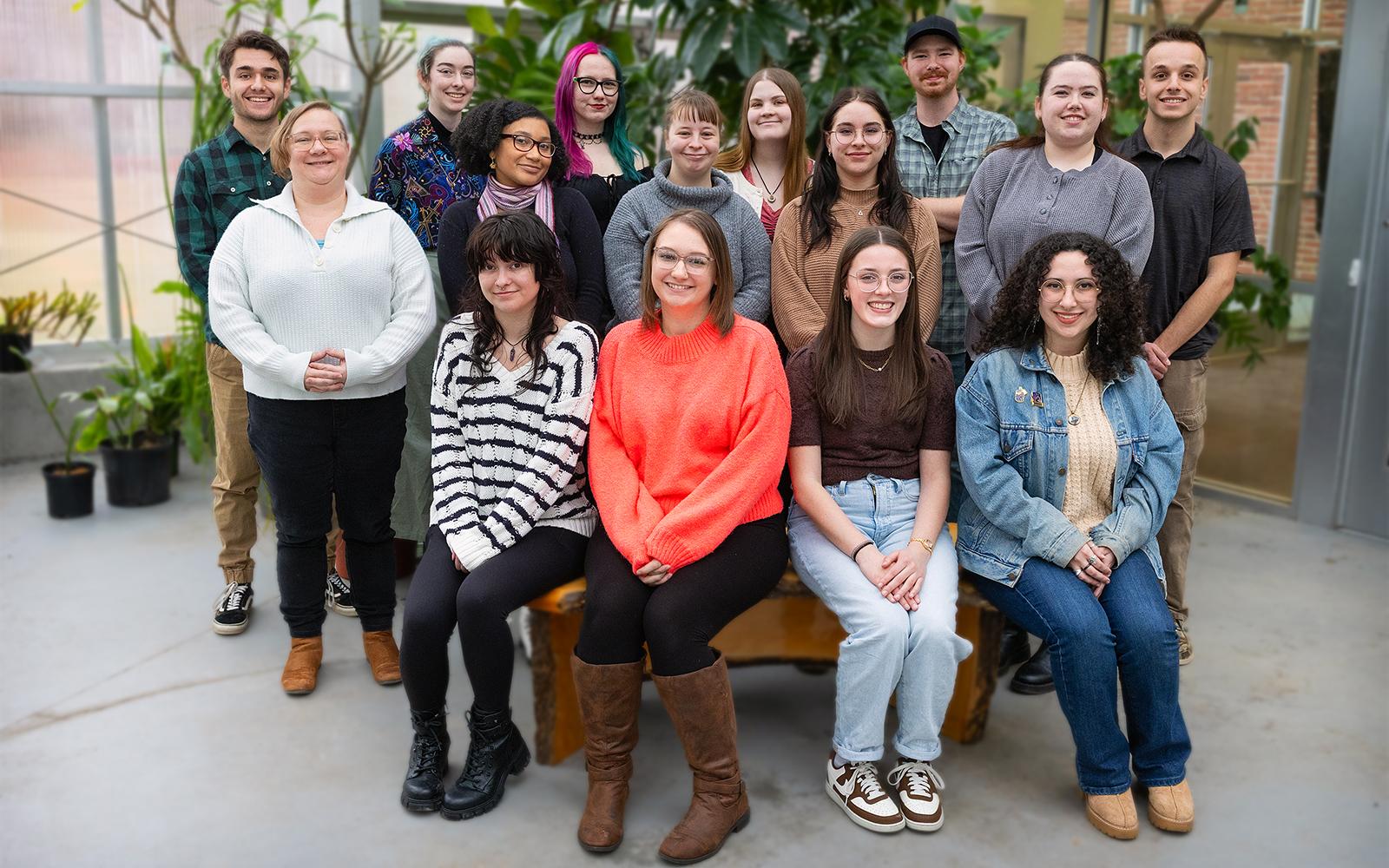
Cantwell and 14 students from her creative writing capstone course pose for a portrait in the WISER Greenhouse. As part of the LoKo Arts Festival, the students presented their original poetry, fiction and nonfiction in the Black Box Theater.
Front row (from left): Liv Claus, Karrie Streeter, Emma Locklin, Adella Duval. Middle row (from left): Faculty member Sarah Cantwell '14 & '17, Daijah Velez, Hellen Howard, Allison Carvel, Evelyn Klein. Top row (from left): Eli Siracusa, Alex Cullum, Em O’Donnell, Jenna Switzer, Zachariah Morehouse, Josef Kaufman.
Path to Potsdam
Cantwell’s path to becoming a writer and professor was anything but a straight line. Despite a lifelong love of creative writing, she didn’t consider it a viable career and instead looked to the sciences as a practical alternative.
“I tried and failed two other college programs before I came to SUNY Potsdam. I had sort of given up on the idea that I was going to graduate from college. My first program was agronomy, so animal and soil science, because I thought that was very practical for the region. I had already done a lot of farm work on dairy farms before. I had been kicked by a few cows; it’s not fun,” she joked.
When agronomy didn’t resonate, she transferred to SUNY Canton to pursue occupational therapy. Her family and friends, knowing how service-minded she was, believed she would thrive in a medical setting.
“Most of my family are EMTs, nurses, fire department members—so there’s always been this culture of service that I grew up in,” Cantwell said.
In theory, it was a natural fit, but as much as she loved helping people, the medical field wasn’t where she belonged. At a crossroads, she enrolled at SUNY Potsdam without declaring a major—this time letting the courses and experiences guide her next moves.
“I decided to just go and see where I ended up. I remember having a conversation with Dr. Vicky Levitt when she was here, and she said, ‘Are you sure you don’t want to try creative writing?’ and I’m like, ‘Well, that’s not very practical; what career could I have with that?’”
Despite her skepticism, Levitt convinced her to enroll in a nonfiction class.
“I was immediately hooked. I realized that I enjoyed storytelling and writing stories about my past. We did memoirs, some autobiographies, and it was a delight,” she said. “I was really enjoying myself, so I took screenwriting and then poetry.”
Cantwell had found her calling. She enrolled in the B.F.A. program in creative writing, concentrating on nonfiction while also diving deep into poetry. She also discovered the Writers' Block (SUNY Potsdam's writing center), where she worked as a student assistant supporting her peers as they revised and refined their work.
“The Writer’s Block is a foundational and fundamental component of the College because it’s for everyone, for all their writing needs,” she said.
Her perspective on the value of a creative writing degree shifted with each class, as she grew steadily as a critical thinker. After graduating cum laude with her B.F.A., she enrolled in the College’s master’s degree program in English & Communication, focusing extensively on high-level poetry, while also working as assistant director at the Writers’ Block.
“I worked with service-minded people, asking me to think about who I was as a person, who I wanted to be as a writer, what kind of things I wanted to write about, and it led me to study American literature very deeply,” she said
In 2017, With her master’s degree in hand, she was hired as an adjunct professor in the English department, teaching introductory-level courses in writing and critical thinking. That same year, while teaching at her alma mater, she was also accepted into the rigorous M.F.A. program in poetry and fiction at Vermont College of Fine Arts.
Self-Discovery
When she graduated in 2020, the global pandemic was reshaping the world around her. The in-person rhythms of campus life—the community she had spent years building—were suddenly gone.
“That was one of the things that was traumatic; I had built a system that worked well for me, and then the pandemic undermined all of it. Suddenly there was no regular routine of going to campus and working directly with students, going to my office or going to the library, I missed that community of practice,” Cantwell said.
Without that structure, and the pattern of social connection she relied on, she felt out of sync and began looking for answers. After meeting with medical professionals, Cantwell was diagnosed with autism and ADHD.
“That made me question a few things about how I was going to proceed. It affirmed a lot of things, and it made me more conscious about taking care of myself,” she said. “I’m kinder to myself, which is something that I desperately try to encourage our students to do as well, and make sure they are setting up a sensory environment that supports them.”
Through her own self-discovery, she has become a more perceptive mentor—and in her lectures, she now explores the connections between neuroscience and creative writing directly.
“We do a unit in most of my classes now that talks about sensory information. Creative writing and neurology are very fun subjects, and it’s wonderful once you start understanding the impact of writing on the brain and our brain’s capacity to adapt to things,” she said.
Creating Opportunities for her Students
Outside of the classroom, Cantwell oversees Blueline Magazine, one of America’s longest-running nature magazines, with poetry, fiction, nonfiction and visual art dedicated to the Adirondack region. During her undergraduate years at the College, she had the opportunity to intern at the magazine herself.
“I came on as an intern in 2012. It was awesome, because it was also three months after I had a baby. It was fortuitous that I had this great internship opportunity as a new parent. My son has had the pleasure of basically growing up on SUNY Potsdam grounds,” Cantwell said.
Now, more than a decade later, Cantwell has taken on the role of editor-in-chief following the retirement of longtime English professor Dr. Donald McNutt. She is continuing his mission and helping students gain the same hands-on experience she once had—while developing valuable skills in magazine publishing.
“That’s one of the things that we teach the interns: you have to see this magazine as more than a cool product at the end; it is a large-scale community collaboration project. One of our goals is always to display the transformative quality of the natural world on the human experience,” she said.
The 2026 issue of Blueline includes poetry and nonfiction featuring work by award-winning author Robin Wall Kimmer. The newest issue of the magazine also showcases stunning landscape photography by Janice Prichett.
“It’s a wealth of riches that we get submitted to us from the community,” Cantwell said.
During the Spring 2026 semester, five students completed editorial internships, closely reviewing content submitted to the magazine and helping Cantwell prepare poems and articles for publication.
“When we get close to having the main layout done, we have this wonderful tradition where we go over to Flagg Hall with all the pieces selected and we lay them all out down the hallway. It’s a bit of a puzzle to figure out, and it gives us our first main layout for the magazine. We re-stack it in the order, and then we will go and create that first digital draft,” she said.
Student opportunities span the full scope of the publication, from editorial and graphic design internships to public relations roles focused on promoting the magazine.
“We have been blessed to have the Presidential Internship Program. We have two wonderful candidates for a PR internship, where they help us go around the Adirondack region and talk to vendors. This year we’re going to focus on expanding our outreach to the libraries. Students really get an in-depth view of all the stuff that goes on behind the scenes,” she said.
Cantwell also creates unique internship opportunities for her students through her own small business, Illuminacrum Studio Arts LLC, which specializes in creating tabletop role-playing games. Available through DrivethroughRPG.com, her first book, “How To Survive… Zombies If You’re A Zero,” provides a framework for players to create characters with different skills in the zombie apocalypse.
“A group of players and the narrator will come together and do collaborative unscripted storytelling. The idea is that the story gets created between the players and the narrator, and that it is what we call emergent storytelling,” Cantwell explained.
Four SUNY Potsdam students recently completed an internship at Illuminacrum, collaborating with Cantwell on her next book, "Decay in the Depths: A Heroes of the Rime Story," by developing a playtest module, "Decay in the Depths: A Heroes of the Rime Story," another interactive publication built around a foundational fictional tale that expands as participants play the game.
Her distinctive approach to teaching—rooted in community, self-awareness, and experimentation—offers students something far richer than technical skills alone. They learn how to support one another, push their writing forward, and grow as people.
“It is the most rewarding work to help someone reach their potential,” Cantwell said. “We just had commencement and I love watching students walk across that stage knowing that they’re going to go out into the world well-informed and well-prepared.”
Article and photos by Jason Hunter