
For SharonMarie Bartz ’25 & ’27, hands-on learning opportunities have continued to shape her educational experience at SUNY Potsdam.
From an internship on the American Revolution to a project examining the psychology behind propaganda during the World Wars—Bartz has been breathing life into the past through her passionate research.
“I think that SUNY Potsdam’s emphasis on applied learning really helped me solidify which direction I wanted to take my education in, and gave me invaluable knowledge and experience that I’ve found myself referring back to on the daily. I’ve really enjoyed my time at SUNY Potsdam. It was my first choice, and I’m still so glad I went here,” she said.
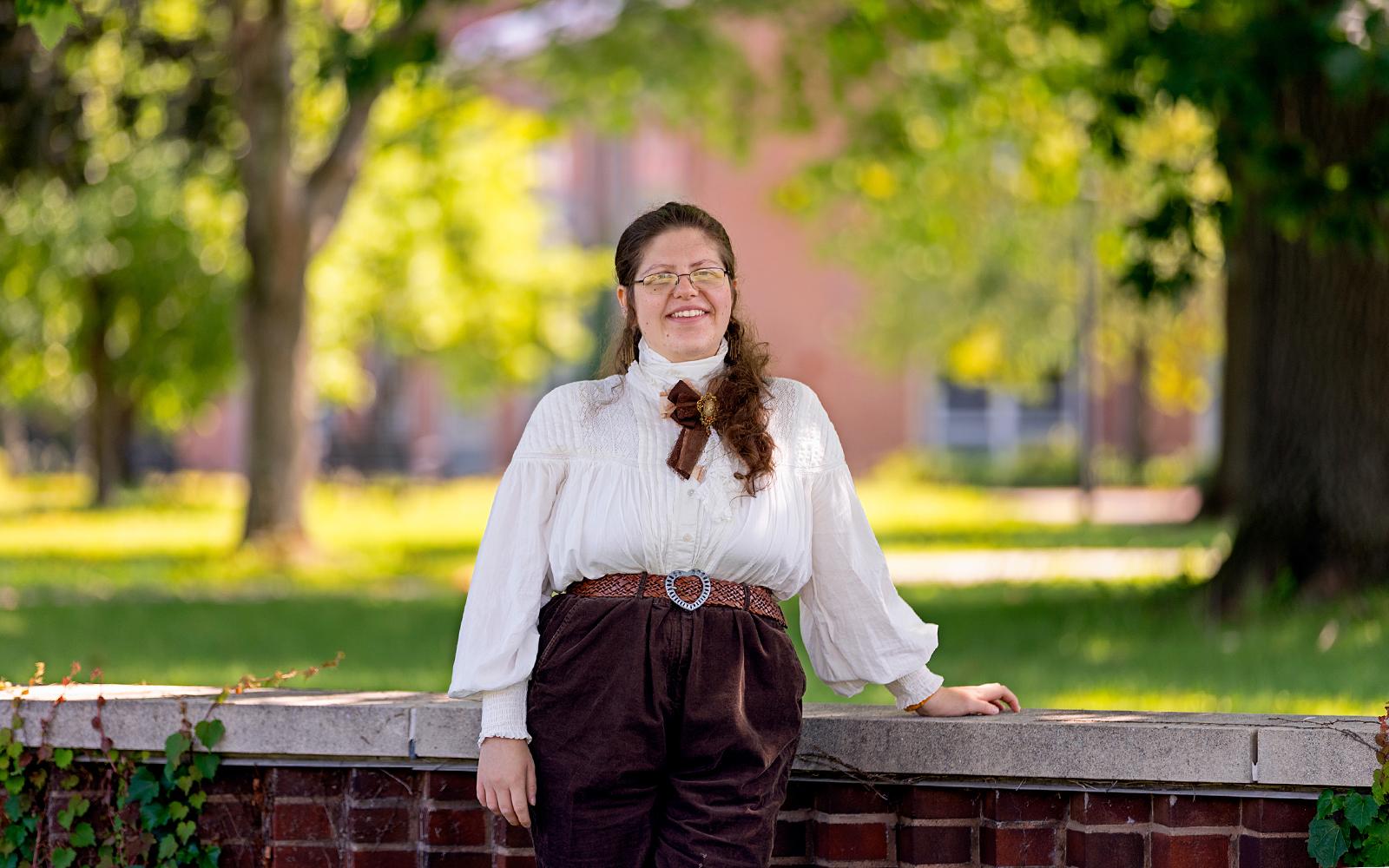
Bartz, a double major in history and philosophy with a minor in psychology, joined a cohort as one of six students selected for internships around New York State focused on the local history of the Revolutionary War. Part of the Gardiner Summer Fellowship Program, she logged 150 hours working alongside the town historian in Clarkson, N.Y., where she combed through historic records to get a glimpse at life in the 1700s.
“I really liked working with my local historian. They gave us an office in our town court actively being used as an interrogation room, and whenever we weren’t in there, we had to lock up the more valuable equipment and artifacts in padlocked metal cabinets,” she said.
With books and documents spread out in the interrogation room, she worked tirelessly to uncover stories from the founding of our country, told on a local level. Unfortunately, many historic letters and other documents damaged when rats burrowed into the attic where they were kept back in the 1970s, so much of that material wasn’t available to her. It forced her to get creative with her research, and led her to discover a book by William Wilkinson, published around 1938, with a handwritten history of the town.
“I transcribed the first volume of his handwritten book, and am now on the second volume. He had documented all the oral history from our area, and he interviewed some of the oldest residents. He had a lot of personal anecdotes. It was very interesting to see how times have changed from 1938 until now,” she said.
Her research continued when she arrived back on campus that fall. A student in the Presidential Scholars Program, Bartz delved into a unique research project looking at propaganda materials used during WWI and WWII.
“My thesis was that the wars couldn’t have happened to the same extent without propaganda, and I was looking at how propaganda impacted the people who fought, or the people who stayed home, both positively and negatively,” she said.
Combining history, art and psychology, she compared the approach of American, British, German, Japanese, French, Italian and Russian governments to sway public opinion. She said that religion was a tool used to advocate for war and recruit young soldiers during WWI in the U.S. and U.K.
“After the veterans returned to the various countries, when it was realized just how bad the First World War was, a lot of people felt duped and that they’d been used by this religious marketing. And so that’s why in WWII you don’t see a lot of this religious marketing, because it had failed so badly during the first war, and many felt insulted that their piety had been used to sell them atrocity,” she said.
Bartz received funding through the Lougheed Center for Applied Learning, allowing her to visit museums around the country and see the original propaganda pieces used in the early 20th century.
“It meant that I was able to take a trip down to New Orleans to spend five days at the WWII Museum, and that was fantastic. I waited in line until they opened and they kicked me out at the end of the day. It was great. They have a huge collection and a whole section that was just propaganda. I was there day in and day out,” Bartz said.
She even had the chance to work one-on-one with a museum curator at the WWII Museum and take an additional tour behind the scenes in the vault. The funding also allowed her to visit the Holocaust Museum in Washington D.C., and a separate WWII Museum in Eldred, Pa.
Back at SUNY Potsdam, she shared her research with the campus and community, leading to a special series of talks at the Potsdam Public Museum.
“They kindly hosted my week-long lecture series on propaganda and the World Wars, titled, ‘Manipulating the Masses: A Citizen’s Guide to Propaganda in the World Wars,’ a program directly supported by SUNY Potsdam’s funding of my research,” she said.
As an extension, she also took class required for her minor in museum studies—learning archival methods for handling art and historic documents, and helping install art exhibitions in the College’s Gibson Gallery, including a retrospective of work by accomplished photojournalist Stephan Savoia.
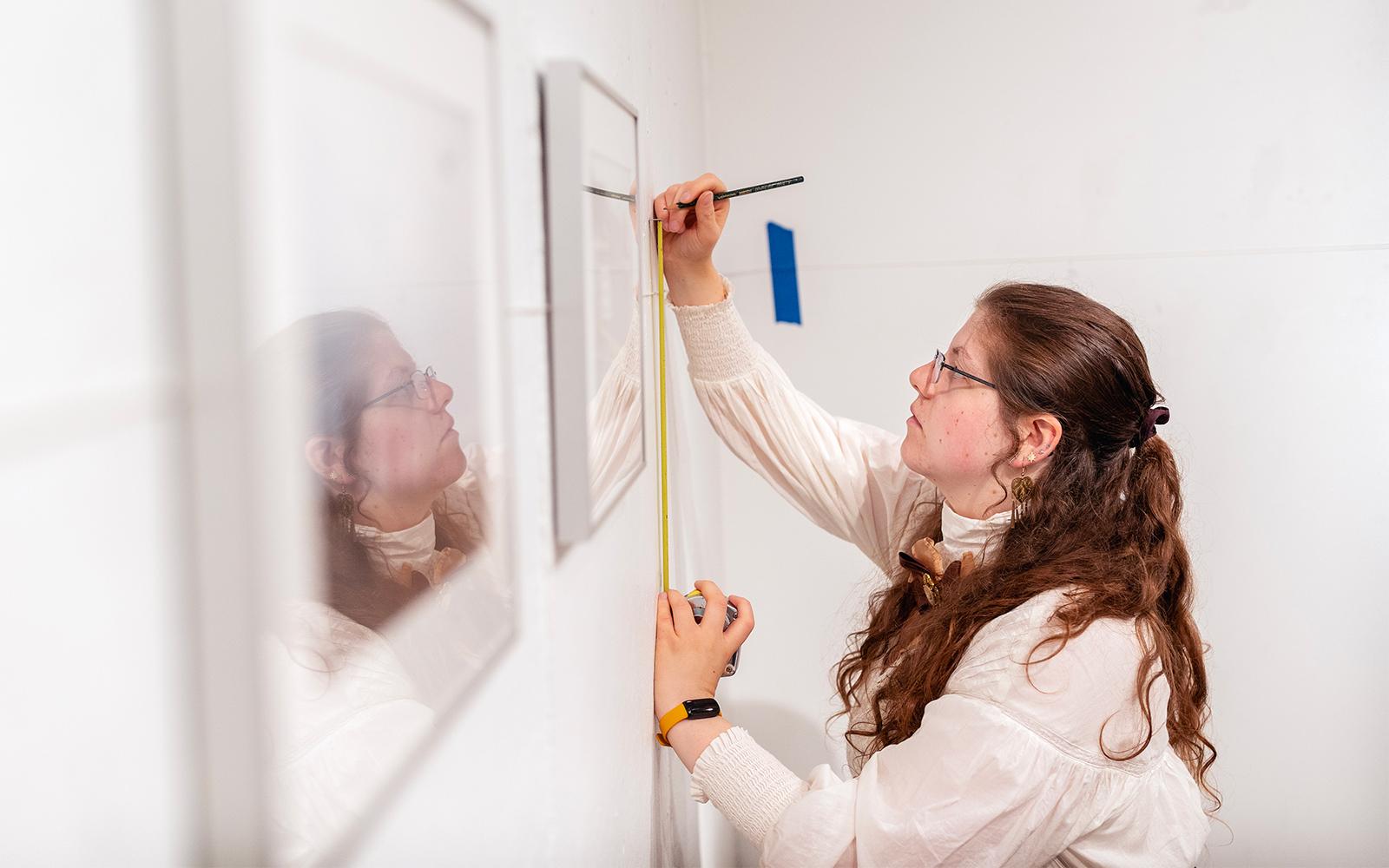
“My various internships, including the Gardiner Fellowship Program, and my volunteer work for both the Potsdam Public Museum and the SUNY Potsdam Gibson Gallery, have taught me a lot about educating and designing spaces for the public,” she said.
Bartz thrived in these applied learning experiences, equally as much as she did in her classes. From Akwesasne Public History with Dr. Tom Baker and African history with Dr. Libbie Freed to classes on the ancient world with Dr. Steven Stannish and Dr. Lydia Rodriguez, Bartz landed on the President’s List every semester before graduating summa cum laude in 2025.
Now she’s back on campus pursuing her master’s degree in secondary education. The graduate program will open the doors to teaching history at the high school level, with the prospect of becoming a college professor or institutional public-facing historian in the future. When she walks across the commencement stage again in May 2027, she is looking forward to combining her passion for education, research and museum work as she contemplates a PhD program in history.
“I got to meet and work with so many lovely and deeply insightful people, and make meaningful connections I could not have developed without my work through SUNY Potsdam’s applied learning programs,” Bartz said. “I owe my teachers, my peers, and the wider community a great debt for their support and insights through the years.”
Article and photos by Jason Hunter