
Sitting in his high school classroom on Sept. 11, 2001, Kellen Bertrand ’21 watched helplessly as the worst terrorist attack in American history unfolded before him.
At the time, Bertrand was a sophomore at Ogdensburg Free Academy, just 30 miles from SUNY Potsdam. In that moment, he felt a calling to serve his country. “That certainly impacted me and gave me a sense of purpose and desire to contribute,” Bertrand recalled.
After graduating from high school in 2004, he enlisted in the U.S. Navy and immediately began boot camp. Over the next seven years, he served as a Hospital Corpsman, providing care that ranged from routine procedures such as sutures and wound care to life-saving medical interventions. His responsibilities included operating an ambulance, administering vaccinations, drawing blood, and assessing and treating patients in an outpatient clinic.
“I've been interested in medicine for as long as I can remember, and even before enlisting, becoming a Navy Corpsman was my top choice,” Bertrand explained.
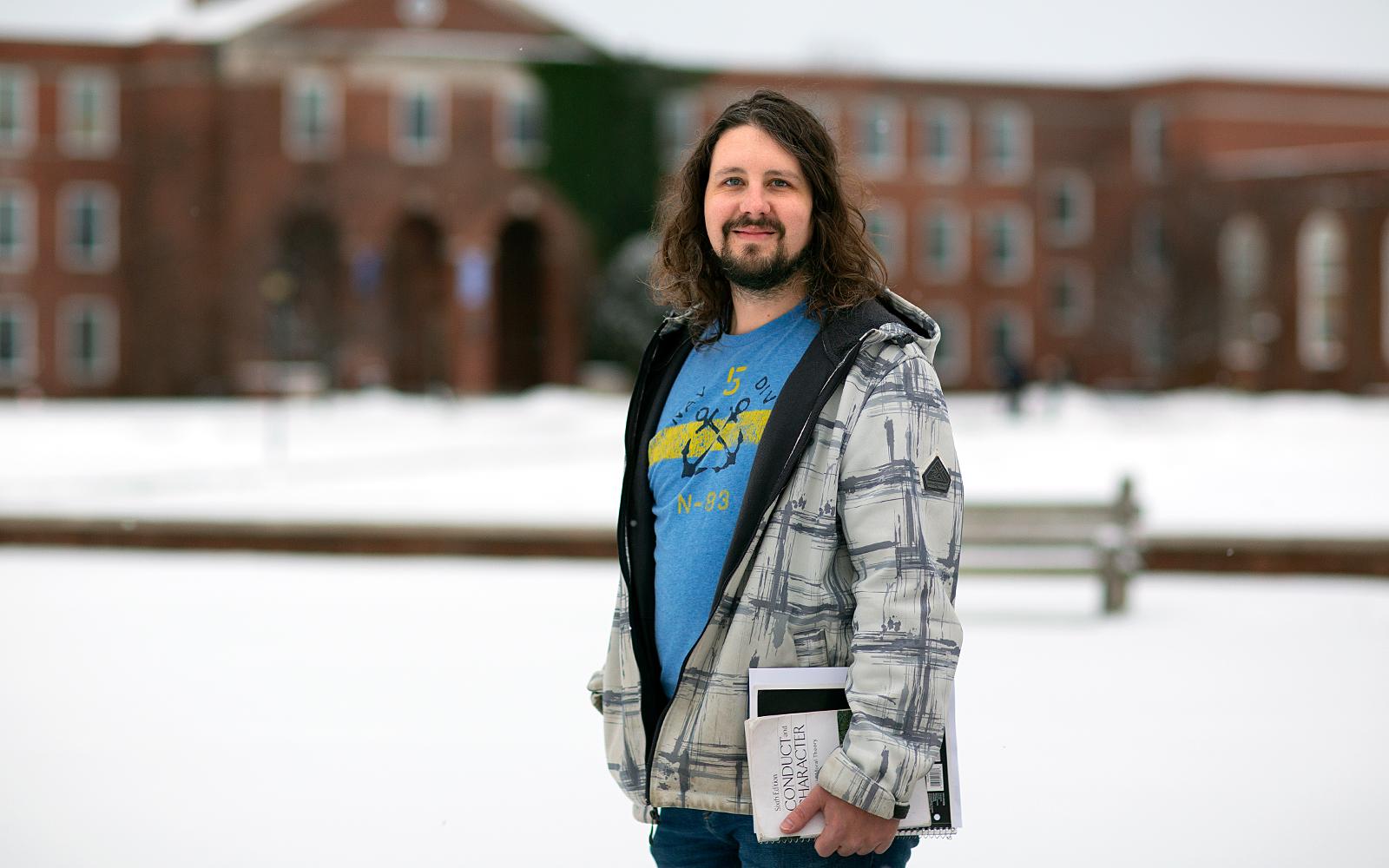
In 2009, Bertrand was deployed to Afghanistan with Marine Aircraft Group 39 out of Camp Pendleton, Calif. For seven months, he was stationed in Helmand Province, where he provided medical care to more than 1,000 Marines. He operated a flight line aid station—a clinic built from military tents along a flight route—and served as a Medevac Corpsman with several Marine Corps helicopter squadrons. His duties also included investigating aircraft damage resulting from collisions or combat, as well as overseeing a mass-casualty staging area in the event of an attack.
On a daily basis, Bertrand worked alongside helicopter crews to transport troops and supplies to forward operating bases, while caring for injured service members until they could be flown to a base hospital.
“I embraced the freedom and responsibility associated with being the sole medical personnel for an entire Marine squadron and gained a wealth of experience not only in medicine but in management,” Bertrand said.
After completing his military service in 2011, Bertrand returned to California and took classes at California State University. In 2017, he moved back to his hometown of Ogdensburg, where he accepted a position at the Claxton Hepburn Medical Center laboratory. Building on both his military medical experience and his hospital work, he decided to return to school to pursue a Bachelor of Science degree in Biology, while also taking Chemistry classes.
“I fell in love with SUNY Potsdam my first semester,” he said. “Professors like Patricia French, Dr. Fadi Bou-Abdallah, and Dr. Robert Snyder made science not only easy to understand, but intriguing.”
One of the defining aspects of a SUNY Potsdam education is the opportunity for undergraduate students to engage in research typically reserved for graduate-level study. Bertrand seized that opportunity by joining Bou-Abdallah’s chemistry lab, where he researched lead detection in drinking water using nanoparticles.
Reinforced by his real-world experience in the U.S. Navy and his professional work at Claxton Hepburn Medical Center, Bertrand excelled academically at SUNY Potsdam and crossed the commencement stage with plans to pursue medical school—continuing a lifelong commitment to service and medicine.
Article and photos by Jason Hunter