
Call it kismet, fate, luck or just crazy coincidence.
At the moment when Emma Marhefka ’21 was on the cusp of her big breakthrough, her Crane School of Music connections and experience came through to propel her onto the stage.
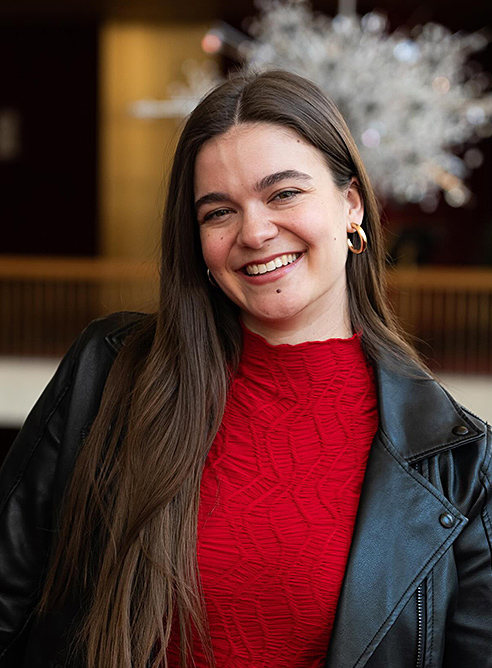
Emma had made it through three stages of the Metropolitan Opera’s Eric and Dominique Laffont Competition—her third time competing—this time, winning the Rocky Mountain regional finals. Out of hundreds of hopefuls, she and 20 other singers had made it all the way to the Semifinals, which meant a trip to New York City and the Met, with two gowns in tow. Her first dress was for the Semifinals, where she and the other competitors performed alongside a pianist onstage before a panel of judges to determine who would advance to the Grand Finals. Just making it this far already felt like a dream, in and of itself.
“There is something magical about that stage. Like when I got up there to sing for the Semifinals, it surprisingly did not feel so huge and overwhelming. It’s almost kind of like an intimate space, the way the acoustics work and the way you are interfaced with the audience, which was so fascinating and unexpected,” she said. “My whole week brought similar experiences, where my first reaction would have been, ‘That’s going to be so terrifying’—but everyone is so supportive and just want you to have a positive experience, and help you out to the best of their ability.”
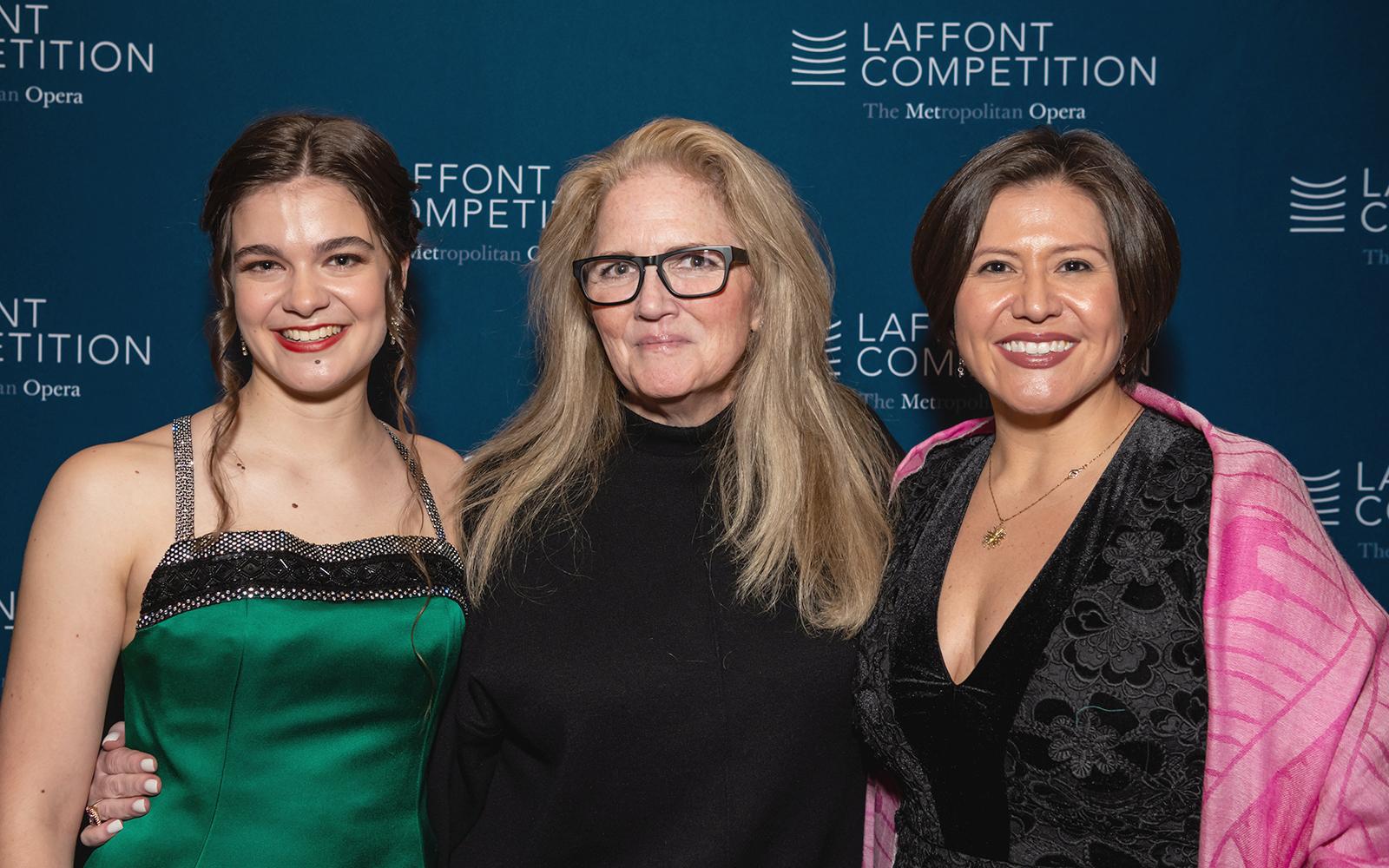
From left, Emma poses for a photo with fellow Crane alumni Margaret Lattimore and Melissa Wegner during the Met's Eric and Dominique Laffont Competition.
When Emma made it through to the final round, it was time to break out her second gown for a wardrobe check—which is when Emma realized that she and another performer had essentially identical outfits. Luckily, Melissa Wegner ’03, the executive director of the Laffont Competition and the Lindemann Young Artist Development Program (and fellow proud Crane alumna) had an extra dress “laying around,” a strapless emerald gown with trumpet hem.
“I tried this dress on, and it magically fit, pretty perfectly. It was a strapless dress and had some beading that I wasn’t in love with, though. I was talking to the costume shop, and they said, ‘We could probably add some straps or some more sequins, but we don’t know whose dress this is, and we have to figure that out to get permission beforehand,’” Emma recalled.
A quick reply from Melissa confirmed that Emma had full permission to alter the dress however she liked… and, in case they needed to know, the previous owner was none other than superstar soprano Renée Fleming ’81!
One of the three previous Metropolitan Opera National Council Audition winners to have graduated from Crane, Renée had given the gown and some other garments as a gift to the Laffont Competition and Lindemann Program, to help rising singers at moments just such as these.
“I was just like, ‘Someone pinch me right now.’ Am I getting punked? I was already living the dream, walking around the Met every day, and I’m going to get to sing with the Met orchestra on the Met stage. And now, I get to wear this custom altered Renée Fleming gown, too.
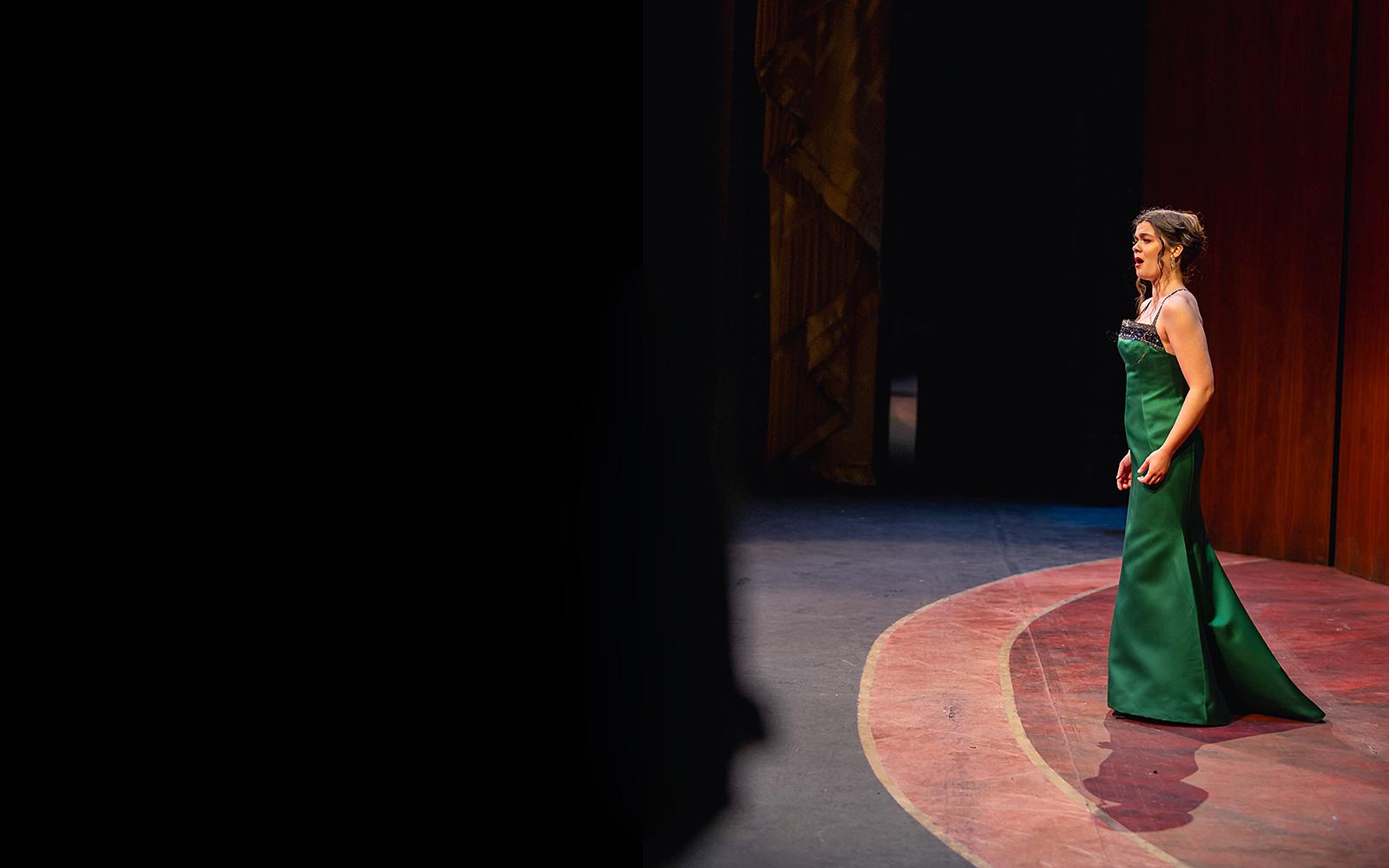
Emma performs on stage at the Met during the Grand Finals of the Metropolitan Opera’s Eric and Dominique Laffont Competition. (Stage photos by Natalia Powers/Metropolitan Opera)
Newly outfitted, Emma took the stage at the big show, before a full audience and cameras livestreaming the performance. Unlike some singers, she didn’t waver from the song selections that had served her so well thus far. She also didn’t waver in her spirit.
“It’s a big moment, and you’re trying not to let it be overwhelming. You also just want to soak it all in, because you know this is special. You don’t know if you will ever get to sing there again—especially in this context, with big, uninterrupted arias with the orchestra and a full house. The audience is so excited, and you are getting huge reactions,” Emma said. “Throughout that whole weekend, but especially on the stage at the Grand Finals performance, it just really made me think back to how I started singing, and the journey that I went on, and being thankful for all the steps along the way.”
She thought back to attending her very first Met Opera performance along with her parents. They were now out there in those seats, watching her. She thought back to her college years, when she and her best friend in her voice studio had season tickets to watch The Met: Live in HD, from the cinema seats at Potsdam’s Roxy Theater.
“It was totally surreal, but so meaningful to be there. And yes, even though it’s scary to be on the Met stage, with this big prize at stake, there’s still this kind of comfort of, you know, why I fell in love with this in the first place—just being able to share a story and music I love,” Emma said.
The singers each performed two arias, accompanied by the Met Orchestra and conducted by Maestro Karen Kamensek. For her performance, Marhefka chose selections from Bellini’s “La Sonnambula” and Mozart’s “Le Nozze di Figaro.”
In the end, she was chosen as one of five winners of the prestigious competition… and in another special nod to the footsteps she was following in, Emma was presented with the Patricia Misslin Award, given by another fellow alumna, the Grammy-nominated mezzo-soprano Margaret Lattimore ’91. Lattimore had established the award in tribute to the late long-time legendary Crane voice faculty member, Patricia Misslin, who had nurtured her career and that of many rising vocalists, including all three Crane winners who had come before Emma—Lattimore, Fleming and Stephanie Blythe ’92.
“It was just an unreal kind of serendipity in that moment,” Emma said.
Where it all began
Raised by a flute-playing mother and a family that encouraged artistic expression, Emma started singing early and fell in love with musical theatre in elementary school in Allentown, Pa. By middle school, she was performing in local productions and began formal voice lessons in Gail Grossman’s private studio—a turning point that set her on a new path.
Initially torn between musical theater and opera, Emma embraced classical training and, on her teacher’s recommendation, auditioned for SUNY Potsdam’s Crane School of Music.
“Crane felt like home,” she recalls, citing the supportive environment and inspiring faculty. Under the mentorship of Professor Emeritus Donald George, Emma honed her artistry, learning that interpretation and character are as vital as vocal technique.
“Her audition showed a mature artist at such a young age,” Donald said. “Emma was super fast at learning new repertoire and memorizing (which is so important for a professional singer). Even with her scholastic studies, at which she excelled, she always sang and performed beautifully and with skill and ease. Emma is not only a superb singer, but also an incredible person full of warmth and kindness. I foresee a great career for her.”
She also interned for a summer on the Fall Island Vocal Arts Seminar, which Blythe had developed at Crane to help rising singers and pianists develop their skills through American art song.
Emma got her start performing in the cast of “The Pirates of Penzance” with the Crane Opera Ensemble in her first year, and as a sophomore, was cast in a starring role in the world premiere of Tom Cipullo’s “Mayo,” thanks to the Domenic J. Pellicciotti Opera Prize, founded by Dr. Gary Jaquay ’67.
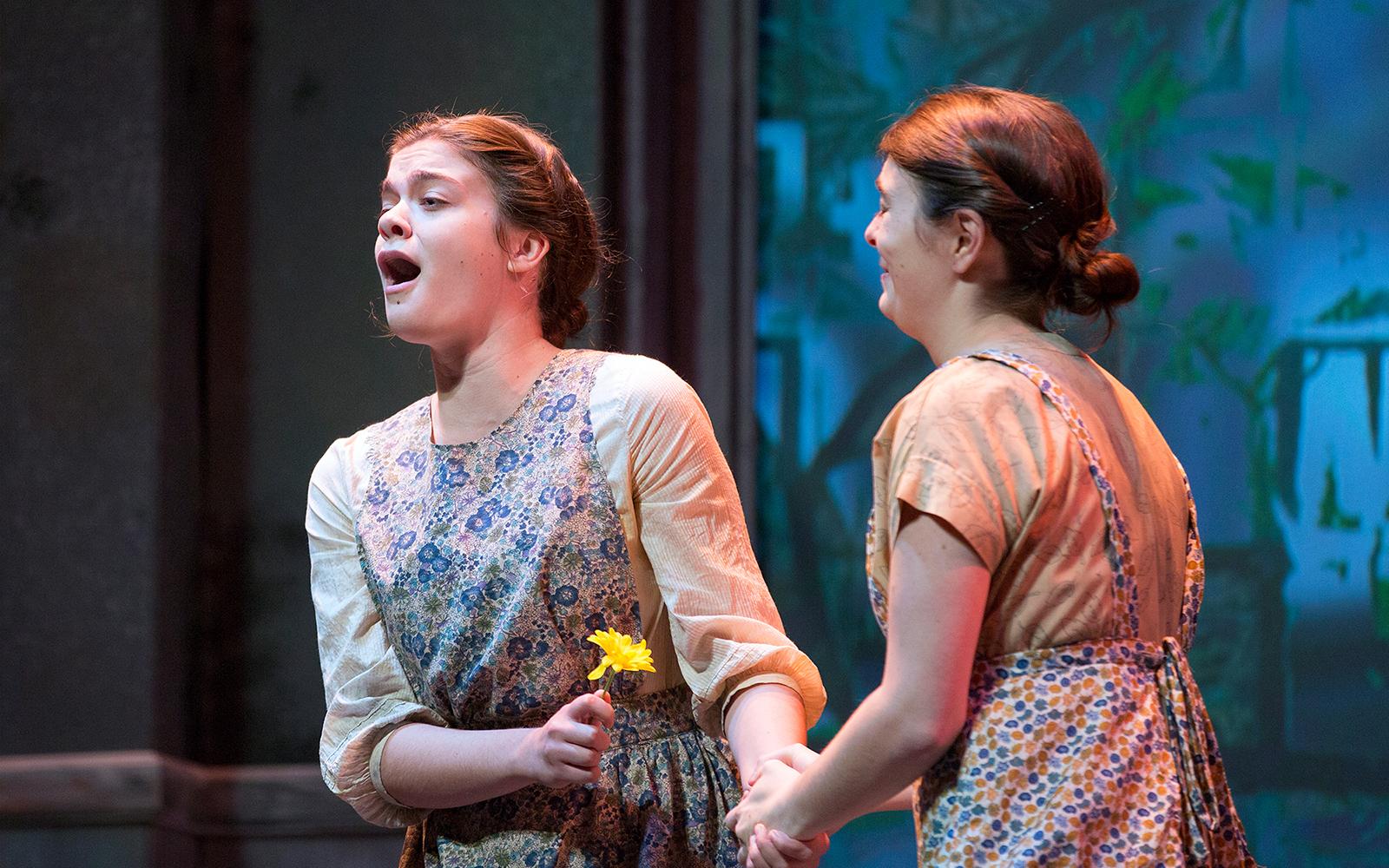
Emma, left, performs on stage during a rehearsal for "Mayo."
“There was something so special about being a young singer, originating a role for the first time,” Emma said. “I think all of us in that production felt that we really do have a place in this large industry, because it's still current and still creating things. I think that was really transformative for me.”
The following year, she had her first turn as Susanna in “The Marriage of Figaro”—back to the world of operatic tradition, though in a unique staging, set in 1950s Palm Springs. It’s a role she later returned to in graduate school at the University of Cincinnati-College Conservatory of Music. In her master’s program, focused solely on vocal performance, Emma found that she drew extensively on her broad-based education at Crane, in particular the deep performing experience in both traditional and contemporary opera that she had already had as an undergraduate.
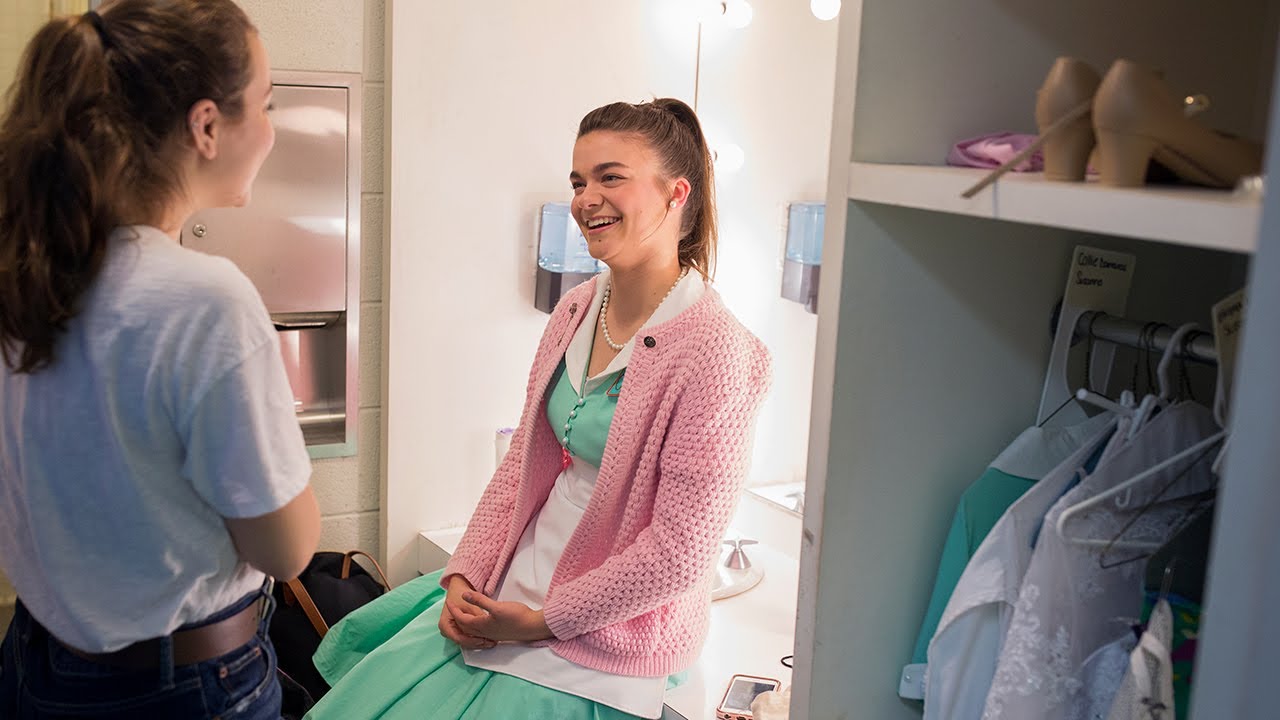
“I think one of the beautiful things about my education at Crane is that it was much more diversified in terms of my musical skills,” she said. “I'm so grateful for the experience and the time I had at Crane. I feel like it really helped me discover and fall in love with this art form and gave me such a solid foundation going forward, and I'm so grateful for that. It’s beautiful how many connections keep coming back to that place.”
In addition to revisiting Susanna and “Figaro,” she also worked on a contemporary opera, “Fellow Travelers,” at CCM, and stayed to complete an artist diploma. Professional opportunities soon followed. Emma’s first gigs came through connections made at Crane, including working with Dean Anthony, who had directed her in “Mayo,” and invited her to take part in the Brevard Music Center’s Janiec Opera Company. Later, he cast her in productions of Cipullo’s “Glory Denied.” Emma advanced through prestigious young artist and apprenticeship programs, crisscrossing the country with different opera companies, leading up to her winning run at the Laffont Competition. She took home a $20,000 cash prize from the competition, but more importantly gained experience and exposure, unlocking new opportunities for her to expand her repertoire.
New roles, new opportunities
Emma went straight from the competition to a run as Gretel in “Hänsel und Gretel” at Opera Montana, and then took the role of Musetta in “La Bohème” at the Santa Fe Opera, a performance Opera Now called “scene-stealing.” Then, she packed her bags and headed for New York to join the Lindemann Young Artist Program.
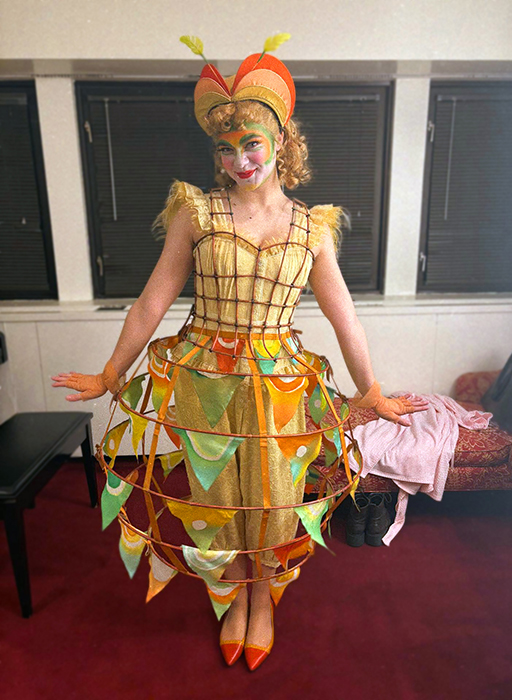
This season, Emma officially had her Met debut—six years to the day since she first attended an opera at the Met with her parents—playing the role of Papagena in Mozart’s “The Magic Flute,” a visually stunning holiday production designed to captivate audiences of all ages.
“It’s the perfect debut,” she said. “It has all the magic of the Met coming into one production. So to be part of that is thrilling and wonderful.”
Beyond performing, Lindemann offers Emma intensive, individualized training—from language coaching to movement classes—and even access to an ear, nose and throat specialist, as she protects the health of her vocal instrument. Best of All? They also have access to complimentary tickets. Emma’s already seen a dozen performances and counting.
Looking ahead, she’ll continue to hone her craft through the Lindemann program over the next year, and is working toward her role and company debut as the lead in “Roméo et Juliette” with Opera Theatre of St. Louis.
“I am overflowing with gratitude,” Emma said. “There are not enough words to express how humbled and honored I feel every day.”
By Alexandra Jacobs Wilke