
Kelly Smith '20 hasn’t only found the silver lining in dyslexia. She’s turned what has been an undeniable emotional legacy into a source of connection and growth for St. Lawrence River Valley teachers and students.
A graduate of SUNY Potsdam’s Master of Science in Literacy program, Smith is a teacher in academic intervention services at F.S. Banford Elementary in Canton. When she isn’t busy working with North Country students, she serves as the executive director of the St. Lawrence Valley Teacher Learning Center. The partnership between the center and SUNY Potsdam's Sheard Literacy Center has been longstanding, but Smith has reinvigorated the relationship with the College. Her most recent work has focused on dyslexia and the Science of Reading in a robust new professional development workshop series aimed at giving educators new insights and tools for helping students. The Science of Reading is a significant body of research that spans multiple disciplines to explain how the human brain begins to read and how to think of the neurobiological condition we call dyslexia.
Dyslexia. Smith uses the word intentionally—after all, one in five people is affected by the condition and, while not rare, it carries a weight of fear and misunderstanding.
“I keep showing up and using the word dyslexia so that people can see that it comes with strengths,” Smith said. “My dyslexia is central to what I do every day. I love working with children and building strong foundations in literacy as an AIS teacher.”
A legacy of alternative learning
The youngest of five children, raised in Great Falls, Montana, Smith was the daughter of a teacher and soon realized she would have to navigate the world of nontraditional learning.
“My childhood can be described with a variety of wholesome adjectives, but the word that I have chosen to best describe me is dyslexic,” she said. “I was diagnosed in the 2nd grade, but did not receive services to remediate the situation. I learned at a very young age to find my own answers.”
Dyslexia has allowed Smith to see the world differently and to stand out in surprising ways, but the awkwardness that goes with difference, the frustration of taking longer to complete tasks, and the feelings of inadequacy lingered with her and became the engine for her search for solutions.
“Long story short, I have become the teacher I needed and will continue to advocate for my younger self every chance I get,” Smith said.
Dyslexia solutions
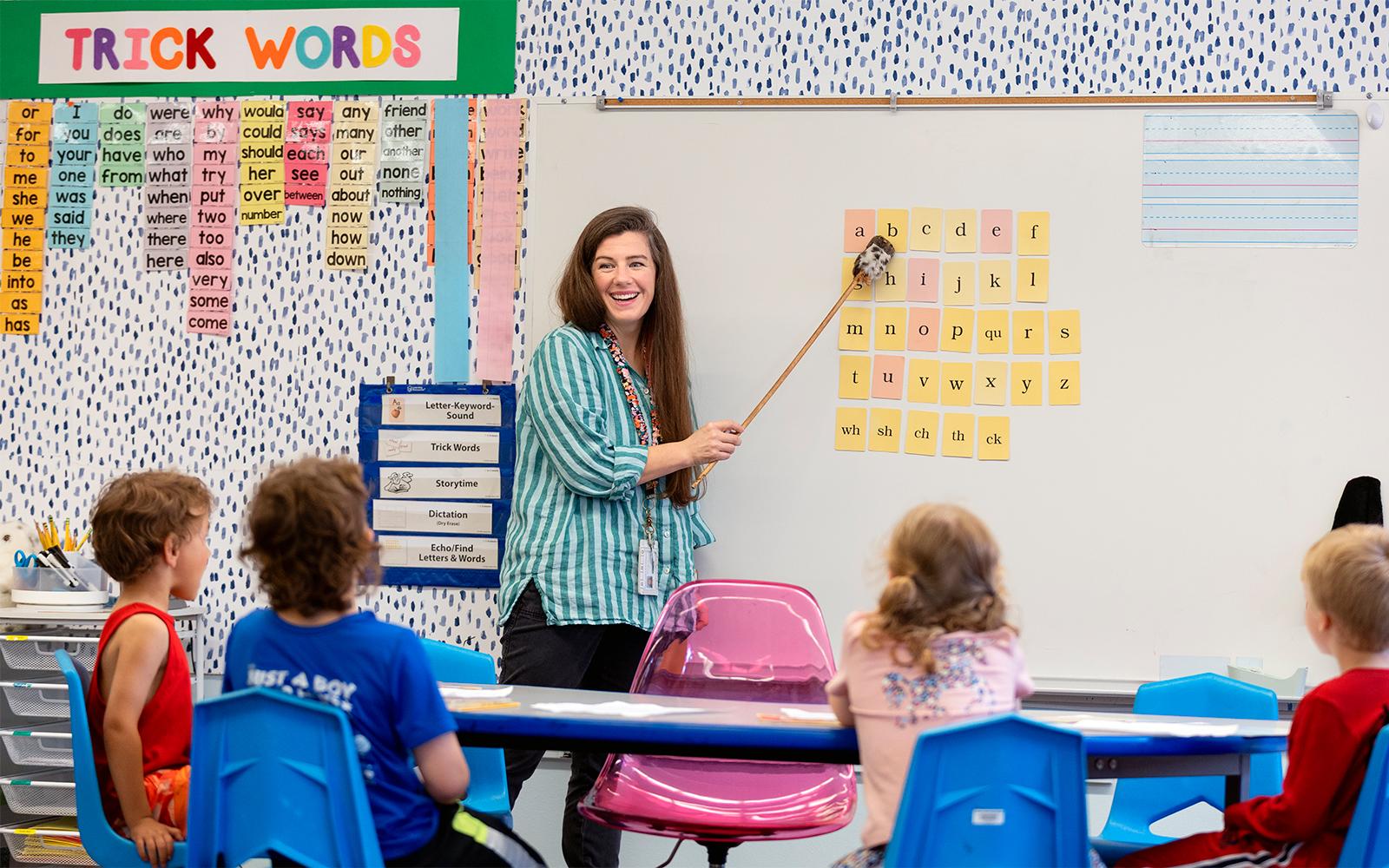
During the 2024-25 school year, Smith sat down with a group of educators and administrators at SUNY Potsdam. It was an emotional moment for Smith. She called on the group to work together to use the Science of Reading as a lens to better understand dyslexia in students. The result was a model classroom in Satterlee Hall and a workshop series called Literacy Learning in Action. The robust lineup—14 sessions in the 2025-26 academic year—has equipped participants with new insight and literacy best practices ranging from systematic phonics programs to encoding skills and student thinking strategies to support growth.
“Each workshop is focused on learning a bite-sized piece of information and making activities related to that topic that can be implemented in the classroom,” Smith explained. “Participants have ranged from classroom teachers and administrators to SUNY Potsdam undergraduate and graduate students and professors.”
Survey results were overwhelmingly positive—100% of the participants indicated they took significant value in the course and would recommend the series to a colleague.
Workshops with a purpose
SUNY Potsdam’s placement among 16 public schools, four universities and St. Lawrence-Lewis BOCES makes the college an ideal locus for dyslexia intervention, Smith said. Combine the kindness, compassion and forward thinking of the leadership at SUNY Potsdam, and the result is a partnership that stands to significantly benefit educational communities and the students they serve in the years ahead, Smith believes.
“The motto of the SLVTLC is ‘A source for teachers, a promise for students.’ We believe that when we empower teachers with knowledge and tools, students reap the benefits,” Smith explained. “I cannot take credit for any of this—the community at SUNY Potsdam and the board that governs the SLVTLC have come together to ignite what it means to be in the North Country surrounded by people who care and want to see children thrive. This partnership will continue to grow because the people involved are putting students first and truly listening to what teachers need in the classroom.”
The impact of the series is spreading and will continue next year, building on lessons learned thus far in how to best reach educators and SUNY Potsdam students, and offering virtual options and online resources.
“Kelly speaks eloquently about the need for more teachers to be trained to work with students like her—students with dyslexia,” said Cary Boles, director of the literacy center at SUNY Potsdam. “This summer, the literacy center is bringing together a small group of passionate local educators, including Kelly, and SUNY Potsdam faculty and staff members to participate in training and assist in the design of a microcredential in dyslexia studies.”
Boles said the long-term goal is to offer a graduate certificate program in dyslexia studies, producing structured literacy dyslexia interventionists who can obtain nationally recognized certification.
Smith’s deft play of the hand life dealt her will help make this a reality.
Article by Bret Yager. Photos by Jason Hunter