
Reading Ready
As Beth Diederich ’27 places her finger on her lips, she carefully sounds out a word with a student at Norwood-Norfolk Elementary School. A three-ring binder at her side guides the lesson, as the student moves letters across a magnetic board.
In this quiet, focused moment, she’s doing more than tutoring—she’s part of a larger shift in how reading is taught. Through a program called Reading Ready, SUNY Potsdam students are helping bring research-backed literacy instruction into local classrooms.
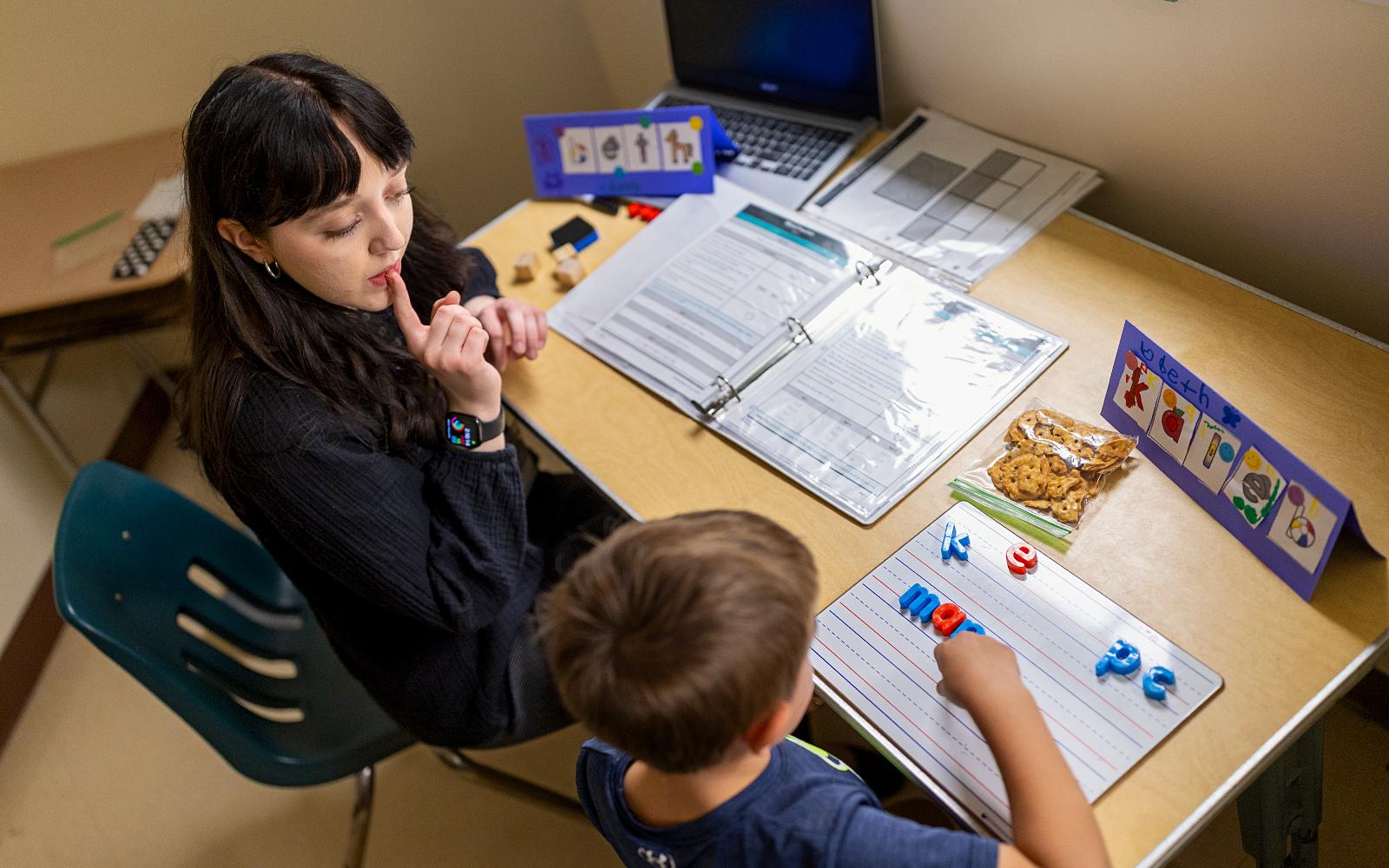
Beth Diederich ’27 tutors a student at Norwood-Norfolk Elementary School.
“It has been a great opportunity for me. This is my first time getting to do tutoring, working one-on-one with a student in the area of reading and literacy," Diederich said.
The SUNY Potsdam junior, who is pursuing a degree in early childhood education, is one of 18 students piloting the Reading Ready curriculum this semester. Every week, she spends two full days in a first-grade classroom observing her host teacher and assisting with lessons. In the afternoons, she steps away to work individually with a student through the structured Reading Ready program.
“I’ve noticed how impactful and helpful the physical manipulatives are in the program. Students get to work with little blocks and chips, where they can physically use them to visualize the letters and sounds that they’re saying and hearing in their head, but with blocks, and not necessarily the letters. As a young reader, I would have benefited from that,” she said.
For Diederich and many of her peers, learning to read once relied more heavily on memorization and a whole language approach. Today, instruction has shifted—grounded in phonics and supported by decades of research.
Kylie Walker ’27, who has been tutoring students at both Norwood-Norfolk and Lawrence Avenue Elementary Schools this semester, has also seen that impact first-hand. Reflecting on her own early experiences, she sees how transformative the approach could have been.
“I was taken out of the classroom in first grade because I was not good at reading—it didn’t make sense to me, I didn’t understand it, and I didn’t like memorizing. But with Reading Ready, I don’t think I would have had as much of a struggle with English and reading,” Walker said. “I could have learned to encode, decode, segment and blend like the students are doing here.”
Now, as a teacher education student at SUNY Potsdam, Walker draws on her Reading Ready training while working one-on-one with children. She keeps sessions engaging with frequent encouragement—offering high fives, a steady smile and gentle reminders that reinforce prior learning.
One of those reminders takes the form of a simple phonics mnemonic designed to reinforce common letter patterns. “Q always has a best friend, U. If I say, ‘oops, where’s Q’s best friend?’ She knows to include a U,” Walker explained.
Faculty Framework
The Reading Ready curriculum, piloted this semester for all students completing their Block I placements, offers a dual benefit: equipping future educators with effective, research-based literacy instruction while delivering structured support to local children.
“The Reading Ready tutoring program is a great way for students to take what they are learning about reading development and the Science of Reading (SoR) in their lecture classes and put these ideas into practice with ‘real students,’ said Cary Boles, the director of the Sheard Literacy Center at SUNY Potsdam.
Since 2024, the College has prepared 39 students to implement the Reading Ready curriculum, as well as two students trained in a similar program, Ready Go, which targets older elementary students.
“Teaching reading can be very challenging, and this program offers a structured literacy curriculum with scripted lessons that illustrate best practices for teaching reading."
On campus, SUNY Potsdam’s teacher education students study the Science of Reading—a comprehensive body of research developed over the past 50 years. Focusing on the “Big 6” skills and competencies—vocabulary, oral language, fluency, comprehension, phonics, and phonological awareness—students apply these principles under the guidance of faculty, including Dr. Marta Albert.
“This is the first semester piloting a required, course-embedded tutoring experience as a way to deepen learning around the Science of Reading concepts and teaching practices for all Childhood/Early Childhood candidates,” Albert said. “We collaborate with The Reading Institute NYC and are a member of its national tutoring collaborative. Through this connection, we have access to two literacy intervention programs—curriculum, materials and training—as well as a 10-hr SoR micro-credential online course. All of this comes at no cost to us.”
SUNY Potsdam is one of just 34 colleges nationwide that is implementing the Reading Ready curriculum in local schools, while also contributing data to the Reading Institute to measure outcomes and refine the program. The initiative began in spring 2024, when the first two SUNY Potsdam students completed the training and worked as literacy tutors at Lawrence Avenue Elementary School. Since then, Boles and Albert have expanded the program, integrating it fully into Block I placements and securing financial support for participating students. In total, 39 students have been trained in the new curriculum over the past two years.
"In addition to tutoring opportunities embedded in a course, many of our other tutors joined this effort independently for the training and work experience," Boles said. "Using funds from America Reads, work study, Empire State Service Corps and foundation funding, the Literacy Center has been able to pay our SUNY Potsdam students working outside of a course for their time when they are planning lessons, tutoring and participating in learning opportunities/coaching."
Real World Training
Behind the scenes, Boles and Albert coordinate with local teachers and administrators to schedule tutoring sessions and ensure alignment with classroom instruction. Albert also visits elementary schools to observe sessions and provide real-time feedback—support that Orianna Cotten ’27 finds invaluable.
“I’m very grateful to Marta. Every single session, I’ve taken time to debrief with her and talk about everything I’m noticing. I think this curriculum is fantastic, everything is broken down so carefully,” Cotten said.
"Reading Ready builds on itself, so with the first step in each session, you work on matching the phonemes to the letters, which is alphabetic knowledge. Then you move on to figuring out the sounds you hear in specific parts of the word, before you practice segmenting and blending. From there, you work with whole words, sentences and a full decodable book. That helps students grow with it," Cotten explained.
While working with kindergartner Aurora Pollock, Cotten has also adapted her approach to better meet her student’s needs. Recognizing the importance of maintaining focus, she incorporates short, intentional breaks into each session.
“That’s brand new. We would start the lesson, get halfway through, and the attention would be out the window. She does well with just taking a quick break, being able to remove herself from the curriculum and go outside for a minute, do a few jumping jacks, take ten seconds to be silly, and then as soon as she gets back, she’s immediately back into the mindset of ‘ok, we’re about to work again,” she said.
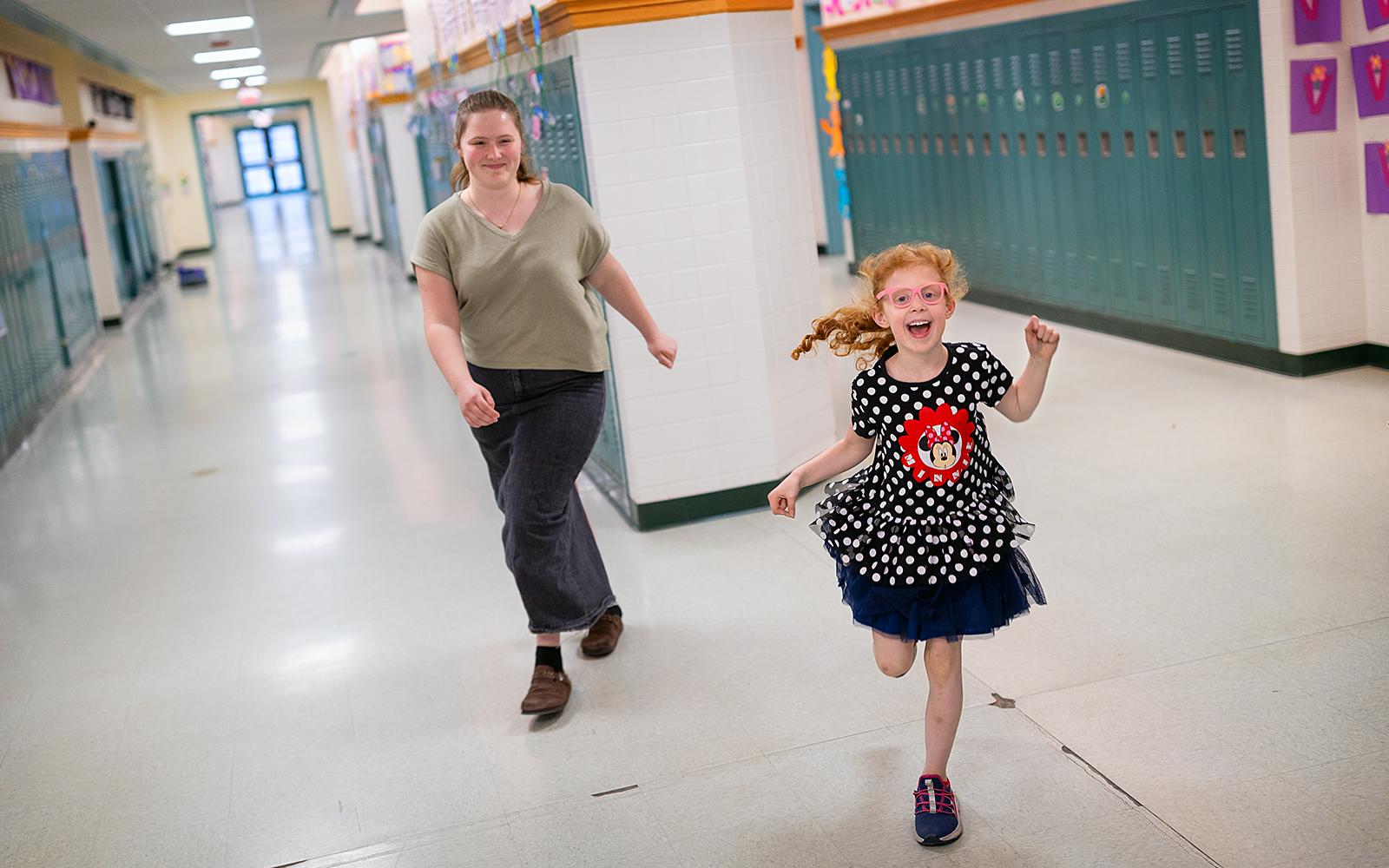
Orianna Cotten ’27, left, takes a quick break to run through the hall with Aurora Pollock.
Through Reading Ready, SUNY Potsdam students continue refining their instructional techniques while building meaningful connections with young learners. For Mackenzie Cardinal ’27, the experience offers both professional preparation and personal inspiration.
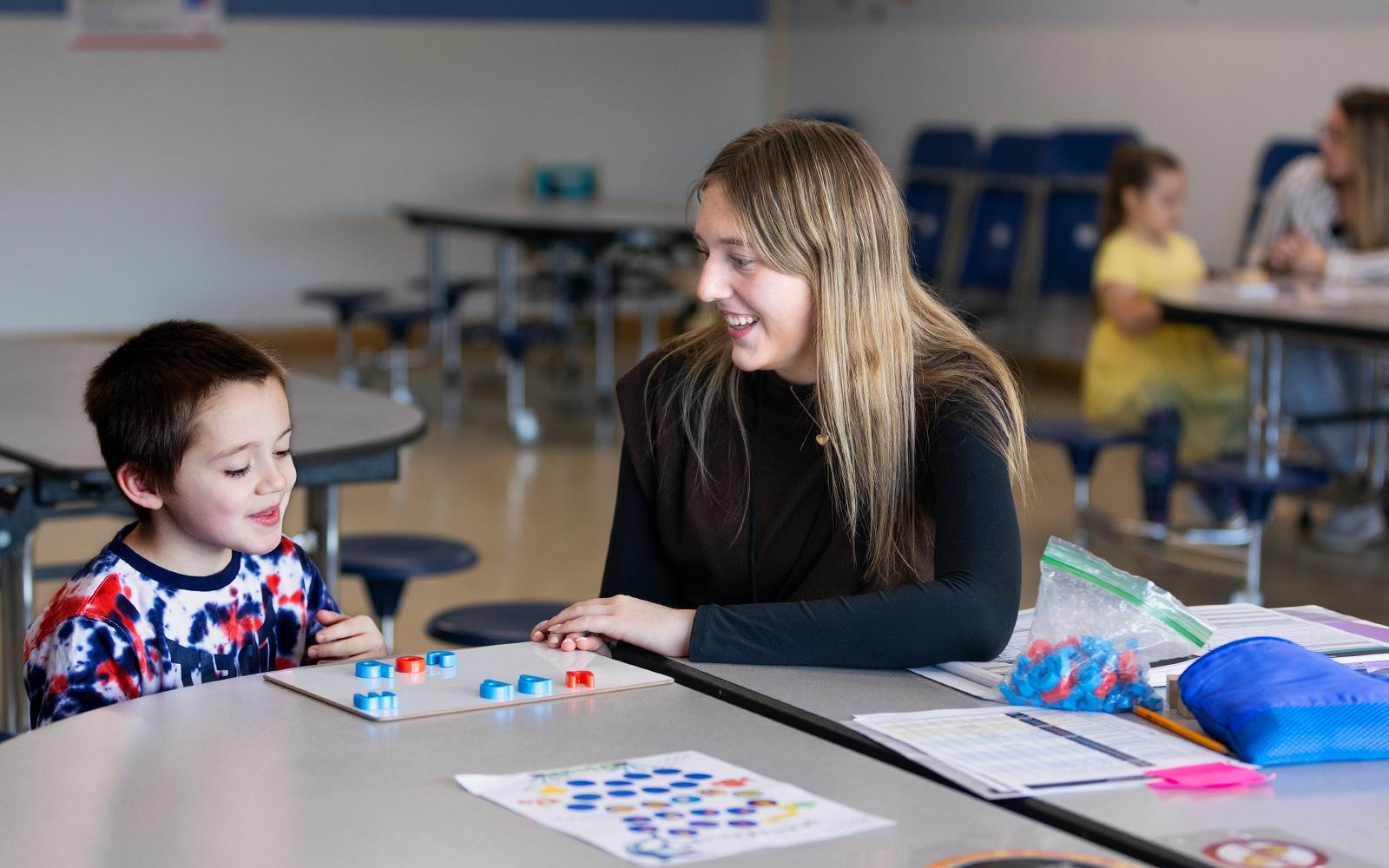
“The experience has been great, just working with the kids, and watching them go through each unit as they get progressively harder, Cardinal said. “Seeing their progress is amazing. I wish we had gotten to do this when we were younger. I love this program because it’s very interactive.”
Article and Photos by Jason Hunter